
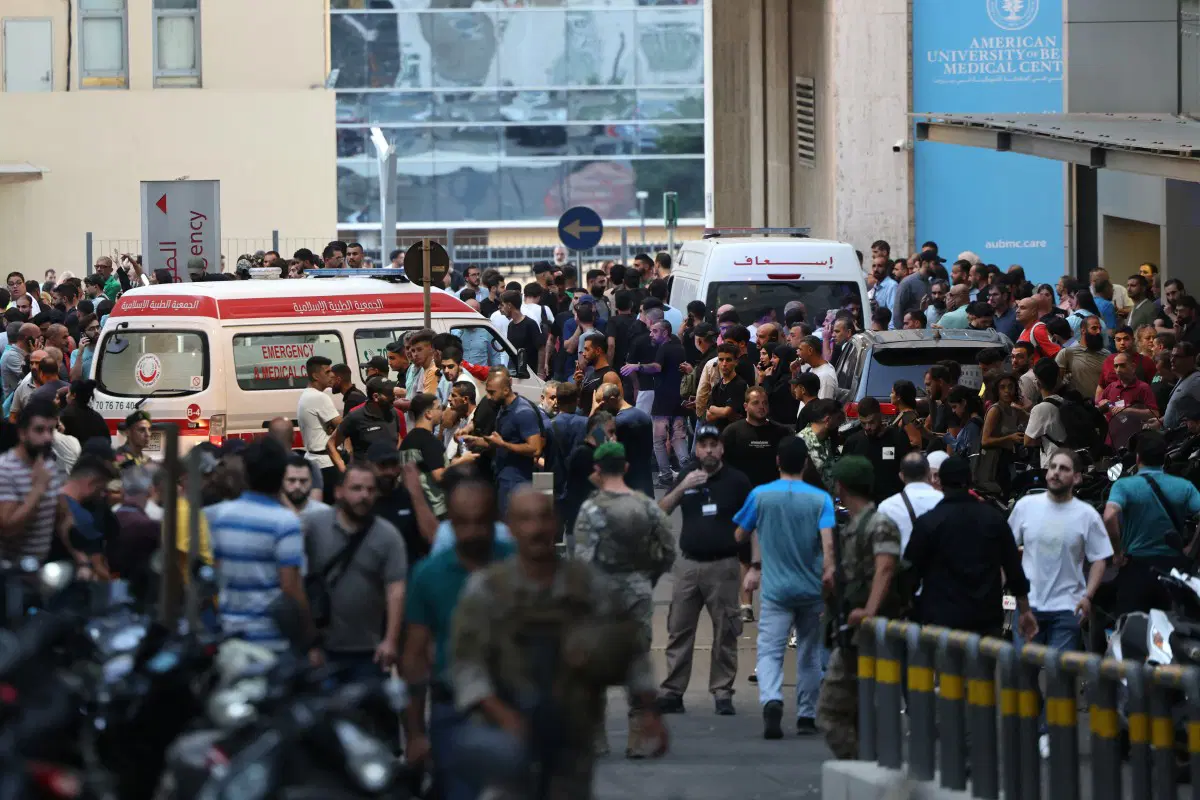
A second deadly wave of unprecedented explosions in the strongholds of Lebanon’s Hezbollah left it in disarray on Thursday, hours before a major speech by its beleaguered leader Hassan Nasrallah.
The latest batch of device explosions killed 20 people and wounded more than 450 others on Wednesday, officials said, stoking fears of a full-blown war with Israel.
The blasts came a day after the simultaneous detonation of pagers used by Hezbollah killed 12 people, including two children, and wounded up to 2,800 others across Lebanon, in an unprecedented attack blamed on Israel.
Walkie-talkies used by its members exploded in the latest blasts at Hezbollah’s Beirut stronghold, a source close to the group said, with state media reporting similar detonations in south and east Lebanon.

AFPTV footage showed people running for cover when an explosion went off during a funeral for Hezbollah militants in south Beirut in the afternoon.
“The wave of enemy explosions that targeted walkie-talkies… killed 20 people and wounded more than 450,” Lebanon’s health ministry said in a statement.
There was no comment from Israel, which only hours before Tuesday’s explosions had announced it was broadening the aims of its war in Gaza to include its fight against Hamas’s ally Hezbollah.
“The centre of gravity is moving northward,” Israeli Defence Minister Yoav Gallant said during a visit to an air base on Wednesday. “We are at the start of a new phase in the war.”
Amos Harel of the left-leaning Haaretz newspaper said the pager and walkie-talkie blasts had put “Israel and Hezbollah on the brink of all-out war”.
– Out of this world –
With tensions in the Middle East spiralling, senior diplomats from the United States, Britain, Germany, France and Italy will meet on Thursday in Paris, sources said, ahead of a UN Security Council meeting planned for Friday.
US Secretary of State Antony Blinken will join his counterparts in the French capital after discussing the possibility of a Gaza war truce in Cairo.
The White House warned all sides against “an escalation of any kind”.
“We don’t believe that the way to solve where we’re at in this crisis is by additional military operations at all,” US National Security Council spokesman John Kirby told reporters.
Iran-backed Hezbollah has traded near-daily cross-border fire with Israel since Hamas’s October 7 attacks sparked the war in Gaza.
Lebanese Foreign Minister Abdallah Bou Habib warned that the “blatant assault on Lebanon’s sovereignty and security” was a dangerous development that could “signal a wider war”.
Hezbollah said Israel was “fully responsible for this criminal aggression” and vowed revenge.
Iran’s envoy to the UN said the country “reserves the right to take retaliatory measures” after its ambassador in Beirut was wounded.
The influx of so many casualties all at once overwhelmed medics.
At a Beirut hospital, doctor Joelle Khadra said “the injuries were mainly to the eyes and hands, with finger amputations, shrapnel in the eyes — some people lost their sight.”
A doctor at another hospital in the Lebanese capital said he had worked through the night and that the injuries were “out of this world — never seen anything like it”.
Among the dead was the 10-year-old daughter of a Hezbollah member, killed in east Lebanon’s Bekaa Valley when her father’s pager exploded, the family and a source close to the group said.
– Heavy blow –
Analysts said operatives had likely planted explosives on the pagers before they were delivered to Hezbollah.
“A small plastic explosive was almost certainly concealed alongside the battery, for remote detonation via a call or page,” said Charles Lister of the Middle East Institute.
The preliminary findings of a Lebanese investigation into the blasts found the pagers had been booby-trapped, a security official said.
“Data indicates the devices were pre-programmed to detonate and contained explosive materials planted next to the battery,” the official said, requesting anonymity to discuss sensitive matters.
A source close to Hezbollah, asking not to be identified, said the pagers
were “recently imported” and appeared to have been “sabotaged at source”.
After The New York Times reported that the pagers had been ordered from Taiwanese manufacturer Gold Apollo, the company said they had been produced by its Hungarian partner BAC Consulting KFT.
A government spokesman in Budapest said the company was “a trading intermediary, with no manufacturing or operational site in Hungary”.
The attack dealt a heavy blow to Hezbollah, which already had concerns about the security of its communications after losing several commanders to targeted strikes in recent months.
As fears surged of a regional conflagration nearly a year into the Gaza war, Lufthansa and Air France announced the suspension of flights to Tel Aviv, Tehran, and Beirut until Thursday.
– ‘Extremely volatile’ –
Since October, the exchanges of fire between Israeli troops and Hezbollah have killed hundreds of people, mostly fighters, in Lebanon, and dozens including soldiers on the Israeli side.
They have also forced tens of thousands of people on both sides to flee their homes.
United Nations rights chief Volker Turk said Tuesday’s attack had come at an “extremely volatile time”, calling the blasts “shocking” and their impact on civilians “unacceptable”.
UN chief Antonio Guterres urged governments “not to weaponise civilian objects”.
The October 7 attacks that sparked the war in Gaza resulted in the deaths of 1,205 people, mostly civilians, on the Israeli side, according to an AFP tally based on official Israeli figures that include hostages killed in captivity.
Out of 251 hostages seized by militants, 97 are still held in Gaza, including 33 the Israeli military says are dead.
Israel’s retaliatory military offensive has killed at least 41,272 people in Gaza, most of them civilians, according to data provided by the Hamas-run territory’s health ministry. The UN has acknowledged these figures as reliable.
In Gaza on Wednesday, the civil defence agency said an Israeli strike on a school-turned-shelter killed five people, while the Israeli military said it targeted Hamas militants.
AFP
