
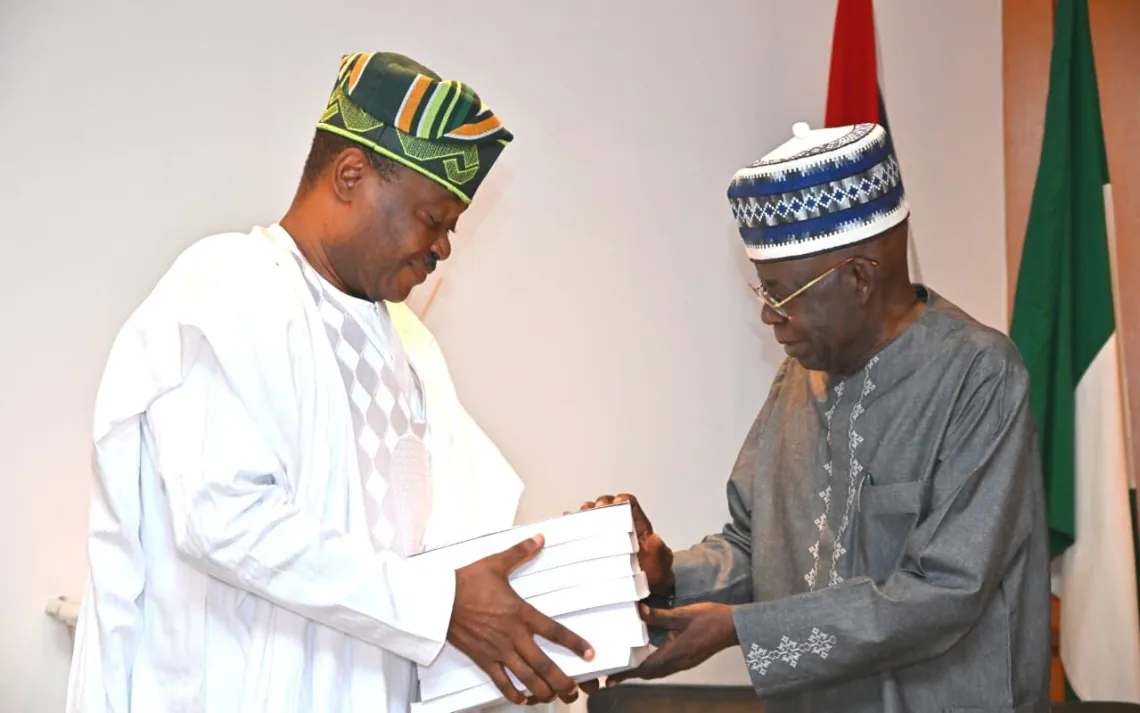
President Bola Ahmed Tinubu has officially received the proposed 2027 United Nations (UN), budget from Nigeria’s Permanent Representative to the UN, Ambassador Jimoh Ibrahim, during a symbolic ceremony at the State House in Abuja on Sunday.
This presentation featured a comprehensive seven-volume document that was submitted to Amb. Ibrahim via the UN General Assembly and the Secretary-General, intended for review by the Fifth Committee, which handles the organisation’s administrative and budgetary matters.
Amb. Ibrahim characterised this event as a historic milestone for Nigeria, noting that it was the first time in 66 years that a Nigerian president had formally received the proposed UN budget through this channel. He emphasized that this presentation underscores Nigeria’s active membership in the international organisation and its involvement in discussions regarding financial and administrative issues.
Beyond its ceremonial importance, the event highlighted the scale of the UN’s proposed expenditures for 2027, which includes funding for regular operations and peacekeeping missions, as well as the process through which member states review, modify, and approve the organisation’s financial plans.

However, there was a notable discrepancy in the figures presented: Amb. Ibrahim mentioned an estimated $3.4 billion for the regular budget and $8.5 billion for peacekeeping, while stating that the total budget was around $14 billion.
This handover came after UN Secretary-General António Guterres submitted the proposed budget to the Fifth Committee. The document was then brought to Nigeria for the president’s presentation.
According to reports from October 19, 2026, the ceremony took place on Sunday, October 18. Amb. Ibrahim informed journalists that presenting the budget to Nigeria was fitting, given the country’s status as a UN member and its participation in financial deliberations.
Why Ibrahim described the event as historic
Amb. Ibrahim’s main point was his belief that the presentation marked a groundbreaking moment for Nigeria’s involvement in the UN budgetary process.
He shared with reporters that this was the first time in 66 years that a Nigerian president had received the proposed budget through this channel. He also highlighted that Nigeria was taking the lead as the chair of the committee that deals with the organisation’s administrative and budgetary issues.
When explaining why he brought the document back home, Amb. Ibrahim stated:
“It’s important to present it to my country since we are a member of the United Nations. I chair the budget committee, so it makes sense to bring the budget back and hand it over to the President.”
He pointed out that this event was particularly noteworthy because the Nigerian president was receiving the entire proposed UN budget, not just a document focused on a specific program or project.
However, the claim about the 66-year gap should be approached with caution. While the reporting confirms that Amb. Ibrahim made this assertion, it shouldn’t be taken as an independently verified fact based solely on his comments. It’s also crucial to differentiate between Nigeria’s role in chairing the committee and the act of presenting the document to the President. While these are connected developments, they are not the same thing.
Understanding the United Nations Fifth Committee
The Fifth Committee is the main committee of the UN General Assembly that deals with administrative and budgetary issues. It plays a crucial role in reviewing the financial aspects of the organisation’s programs and operations before any recommendations are put forward to the General Assembly.
This committee is tasked with examining budget estimates, administrative spending, staffing, and various other financial matters. Its work is essential for member states to understand how the UN plans to allocate resources to meet its obligations.
Under Amb. Ibrahim’s leadership, Nigeria finds itself at the heart of these discussions. The chairmanship offers a vital platform for overseeing the committee’s activities, encouraging dialogue, and managing the review of budget-related issues.
However, it’s important to note that chairing the committee doesn’t mean Nigeria has ownership of the UN budget, nor does it have sole control over spending or the authority to decide how funds are distributed. Budget decisions are part of a collaborative process that involves all member states and relevant UN entities.
Thus, the presentation to President Tinubu can be seen as a diplomatic move, linking Nigeria’s involvement in the committee with the country’s national leadership.
Proposed 2027 budget: figures and financial breakdown
Amb. Ibrahim outlined the proposed budget, emphasizing that it encompasses the United Nations’ regular activities as well as its peacekeeping operations.
He shared some rough figures:
Reported financial estimates:
Regular budget: $3.4 billion
Peacekeeping: $8.5 billion
When you combine these two amounts, you get a total of $11.9 billion. However, the overall proposal stands at around $14 billion.
It’s important to note that these figures are approximate and stem from Amb. Ibrahim’s public comments; they shouldn’t be seen as a finalised budget.
Now, regarding the discrepancy in the reported totals: the combined figures for the regular budget and peacekeeping operations add up to $11.9 billion, which leaves a gap of about $2.1 billion from the stated $14 billion.
This detail is crucial because understanding the total budget is key to grasping the scale of the UN’s proposed expenditures. There could be several reasons for this difference: the overall figure might include additional financial elements, the cited amounts could be rounded or incomplete, or there might have been some inaccuracies in reporting. Unfortunately, the statements available don’t clarify which explanation is accurate.
For a clearer picture, the UN’s official website provides the proposed 2027 program budget in a series of detailed documents that cover various areas, including policy coordination, political affairs, peacekeeping, international justice, security, and more. It’s wise to consult these published materials directly before making any firm conclusions about the exact makeup of the reported $14 billion total.
Lastly, it’s essential to differentiate between the UN’s regular program budget and its peacekeeping budgets. These are distinct financial components and may operate on different budgetary timelines. Merging them into a single headline figure requires a clear understanding of the periods involved and the specific estimates that are included.
What the proposed budget is intended to support
The budget presentation followed Secretary-General António Guterres’s submission of the 2027 proposal to the UN budget committee in New York. According to a report by Channels Television on October 14, 2026, this proposal aims to bolster the organisation’s core responsibilities while also pushing for administrative reforms and efficiency improvements.
Here are the key priorities outlined in the proposal:
– International peace and security: Funding dedicated to peacekeeping operations and related activities that promote global stability.
– Political affairs: Resources allocated for diplomatic efforts and special political missions, with the proposal reportedly including $423 million earmarked for these missions in 2027.
– Sustainable development: Financial support for programs related to development and technical cooperation.
– Human rights and institutional responsibilities: Resources aimed at helping the organisation meet the mandates set by member states.
– Administrative reform: Initiatives focused on cutting down on duplication, enhancing coordination, and making better use of resources.
Additionally, the Secretary-General emphasized a proposed staffing level of 11,150 positions and initiatives under the UN80 reform agenda, which is designed to boost organisational efficiency and effectiveness. It’s important to note that these elements are part of a broader proposal and do not indicate that the spending has already been approved.
The final budget allocations will hinge on the results of the budgetary review and the decisions made by the General Assembly.

Nigeria’s potential benefits from the budgetary process
During the presentation, a key question that came up was what Nigeria could actually gain from its role in the UN budgetary process.
Amb. Ibrahim chose not to detail the specific benefits Nigeria might enjoy, mentioning that talks with other committee members are still ongoing. His answer implies that it would be too early to link the presentation to any specific financial support or commitments for Nigeria.
Instead, we should think about Nigeria’s potential gains in terms of diplomatic engagement, participation in institutions, and chances for collaboration, rather than expecting a straightforward financial boost.
Possible areas of significance include:
Diplomatic visibility: By chairing the Fifth Committee, Nigeria’s representative takes on a key role in discussions about the organisation’s financial priorities.
Participation in financial governance: Nigeria has the chance to weigh in on how resources are distributed across various UN programs and operations.
International cooperation: Being involved in the budget process opens doors to conversations about development, peace, and security issues that matter to Nigeria and other African nations.
Institutional experience: Taking part in negotiations can enhance the country’s understanding of multilateral financial governance.
These points highlight potential institutional benefits, but they don’t guarantee any specific outcomes from the budget presentation. The event itself doesn’t confirm that Nigeria will receive extra funding, contracts, or special allocations.
The $267 million UN conference centre in Kenya
Amb. Ibrahim pointed out the construction of a United Nations conference center in Kenya as a prime example of the organisation’s investment in facilities across its member states. He mentioned a project that’s estimated to be worth around $267 million.
This example serves to highlight the scale of the UN’s institutional activities and expenditures. However, it’s important to note that this shouldn’t be interpreted as a promise that Nigeria will receive a similar project.
A conference facility is quite different from a direct financial transfer to a national government. To truly understand the economic implications of such a project, we’d need to look into its funding structure, ownership, procurement processes, anticipated benefits, and how much local businesses and workers would be involved.
For Nigeria, the key question is whether being part of UN institutions can lead to tangible cooperation, development opportunities, and a strong representation of national priorities. Just showcasing a project doesn’t really answer that question.
The approval process: what happens next?
The proposed budget is still up for review, negotiation, and approval. Amb. Ibrahim made it clear that the numbers could shift before any spending kicks off.
Submission of the proposal
The UN Secretary-General hands over the proposed program budget to kick off the General Assembly’s budgetary process.
Committee scrutiny
The Fifth Committee takes a close look at the estimates, administrative needs, and the financial impacts of the organisation’s programs.
Consultation and adjustments
Member states weigh in on the proposals, discuss their priorities, and might ask for changes to specific allocations.
General Assembly decisions
The relevant recommendations and budgetary issues move through the General Assembly’s decision-making process.
Implementation
Spending happens according to the approved budget and the applicable UN financial rules.
This process is crucial because just presenting a proposed budget doesn’t mean it’s been approved. The seven volumes are part of the financial planning and review process, and the final amounts authorised might differ from the initial estimates.
For more details, you can check out the UN’s official Fifth Committee website, which has all the documentation for the proposed 2027 program budget.
Broader implications for Nigeria’s international standing
The presentation offers a chance to delve into Nigeria’s role in multilateral diplomacy, going beyond just the ceremonial aspects.
To start, having a Nigerian representative chair the Fifth Committee means they get to lead discussions that revolve around the financial and administrative backbone of the United Nations. This role not only brings visibility but also valuable experience in international negotiations.
Next, the event underscores the link between diplomacy and public finance. The decisions made regarding the UN budget have a direct impact on resources for peacekeeping, development programs, political missions, and other international duties. Therefore, Nigeria’s involvement in these discussions is crucial to its larger role as a member state.
Moreover, the presentation highlights the difference between diplomatic gestures and actual policy outcomes. While receiving the proposed budget is a formal step in engagement, its real importance hinges on the quality of the committee’s work, the choices made by member states, and how effectively Nigeria can push its priorities through the established UN processes.
Lastly, the event prompts important questions about accountability and communication. Providing clear insights into the budget’s structure, approval status, and implications for member states would greatly enhance public understanding of what the document signifies and what it doesn’t.
Key issues requiring further clarification
Several points deserve attention as the budget process continues.

|
Issue |
What needs clarification |
|---|---|
|
Total budget |
How the reported $14 billion relates to the $3.4 billion regular budget and $8.5 billion peacekeeping estimate. |
|
Historical claim |
Independent documentation supporting the assertion that this was the first such presidential presentation in 66 years. |
|
Nigeria’s benefits |
Whether the country expects specific programmes, investments or other outcomes from its participation in the committee. |
|
Kenya conference centre |
The verified project cost, financing arrangements and relevance of the example to the UN’s wider spending plans. |
|
Final approval |
The revised estimates and final decisions taken by member states before implementation. |
These questions don’t take away from the importance of the presentation. Instead, they help pinpoint the information necessary to evaluate the event properly and separate what’s been confirmed from claims that still need more proof.
Conclusion
President Bola Tinubu’s receipt of the proposed 2027 United Nations budget from Ambassador Jimoh Ibrahim is a significant moment in Nigeria’s diplomatic journey with the international organisation. This seven-volume document ties Nigeria’s role in the UN General Assembly’s Fifth Committee to the nation’s leadership, shining a light on the financial choices that underpin the UN’s global responsibilities.
Amb. Ibrahim referred to the presentation as historic, noting that it comes after a 66-year gap and coincides with Nigeria’s chairmanship of the committee that oversees administrative and budgetary matters. He emphasized that the proposed budget encompasses regular operations and peacekeeping efforts, while also mentioning that the figures are still open for negotiation and adjustment.
It’s important to note that the budget hasn’t received final approval yet. The reported total of $14 billion needs to be reconciled with the two figures presented, which add up to $11.9 billion.
In the end, the significance of this event will be gauged not just by its ceremonial and diplomatic weight, but also by how transparent the budgetary process is, the final allocations that member states approve, and Nigeria’s capacity to engage effectively in decisions that impact the UN’s work.
