

India’s Suspension Of Indus Waters Treaty Raises Questions Over Water Control Feasibility.
India’s recent suspension of the Indus Waters Treaty (IWT) has sparked debate over whether it can truly halt the flow of the Indus River and its tributaries into Pakistan, in response to mounting tensions following a deadly attack in Indian-administered Kashmir.
The 1960 treaty, brokered by the World Bank, has long governed the sharing of six rivers in the Indus basin between India and Pakistan. Despite surviving two wars and numerous political tensions, India’s decision to suspend the agreement marks an unprecedented shift in its water diplomacy.

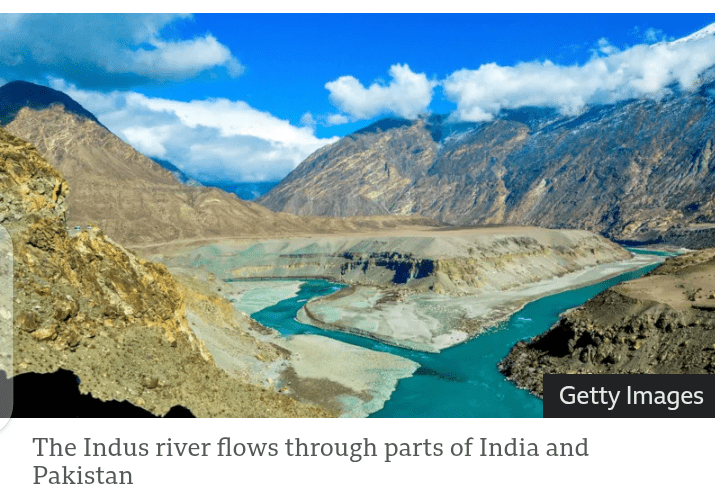
The move is one of several retaliatory actions taken by India after accusing Pakistan of backing cross-border terrorism—an accusation Islamabad strongly denies. In response, Pakistan has warned that any attempt to obstruct water flow would be considered “an act of war.”
Under the original terms of the IWT, India was allocated exclusive rights over the eastern rivers—Ravi, Beas and Sutlej—while Pakistan retained access to 80% of the western rivers—Indus, Jhelum and Chenab. Pakistan relies heavily on these waters for agriculture and hydropower, making the basin a critical national resource.
The suspension has raised serious concerns over whether India could feasibly disrupt river flows. However, experts argue that India lacks the necessary infrastructure to hold back or divert the vast volumes of water that pass through these rivers, especially during peak flow seasons.
“The infrastructure India has are mostly run-of-the-river hydropower plants that do not need massive storage,” explained Himanshu Thakkar, a regional water expert from the South Asia Network on Dams, Rivers and People. These plants generate electricity by using the river’s natural flow without storing significant amounts of water.
Furthermore, Indian authorities have acknowledged that despite being entitled to a 20% share of the western rivers, the country has not been able to utilise it fully due to inadequate infrastructure—a point often raised to justify new water projects that Pakistan views as treaty violations.
With the suspension in place, India may now proceed to modify existing water infrastructure or develop new projects without needing to consult or share documentation with Pakistan—an obligation that previously existed under the treaty.
While India’s geographic position as the upstream country offers a theoretical advantage, experts believe it is unlikely to translate into immediate or large-scale water control. The geopolitical and technical implications of such a move would also be significant.
As tensions continue to escalate, the future of one of the world’s most significant transboundary water-sharing agreements hangs in the balance, with regional stability and millions of livelihoods at stake.
