
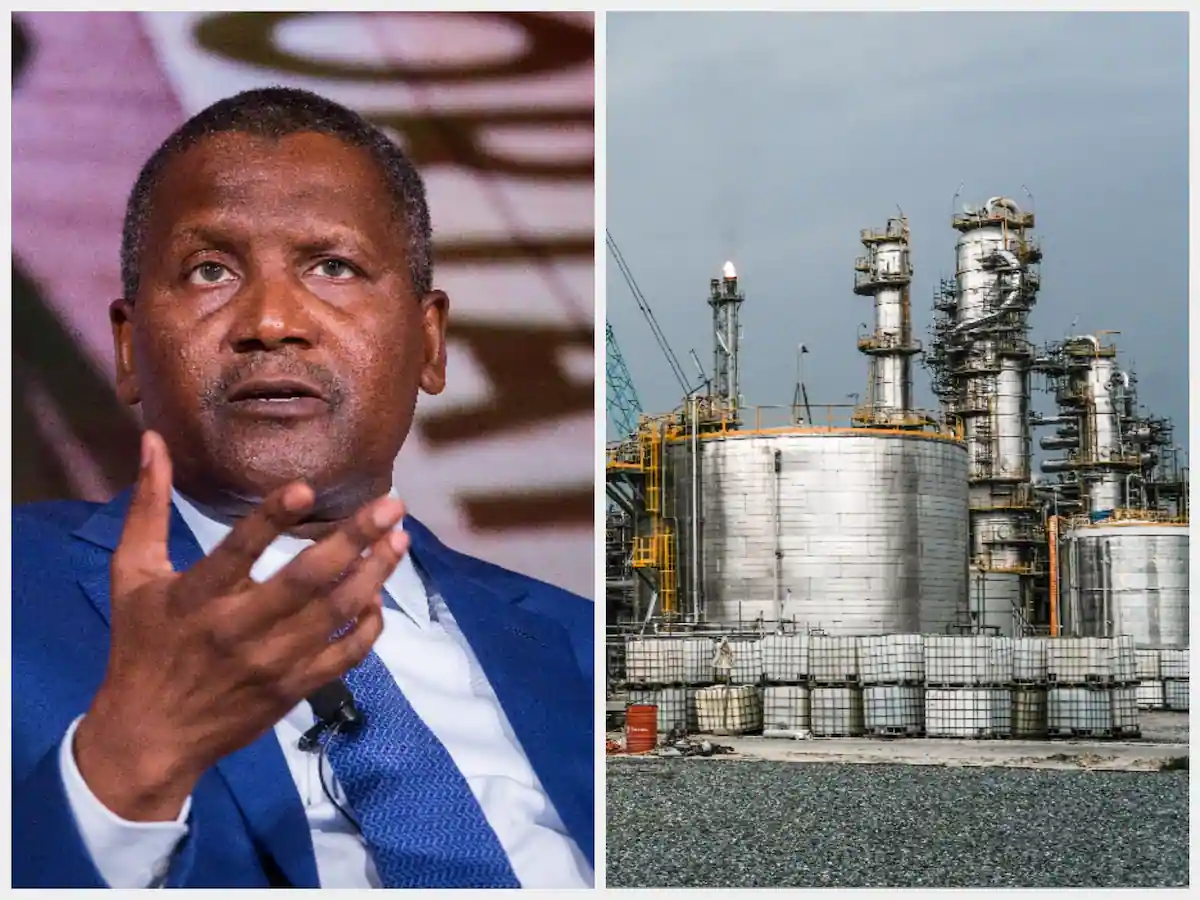
“They Have Spent $18bn On Those Refineries And They Are Still Not Working” – Dangote.
Alhaji Aliko Dangote, President of the Dangote Group, has expressed deep scepticism about the future of Nigeria’s state-owned refineries in Port Harcourt, Warri, and Kaduna, declaring that despite an $18 billion investment, they remain non-functional. Speaking on Thursday while hosting members of the Global CEO Africa programme from Lagos Business School at his 650,000-barrel-per-day refinery in Lekki, Lagos, Dangote questioned whether the Nigerian National Petroleum Company Limited (NNPC)-managed facilities would ever operate effectively.
He highlighted the inefficiencies of the NNPC refineries, noting that when operational, they produced a mere 22% of their output as Premium Motor Spirit (petrol), compared to over 50% at his Lekki facility. Reflecting on past involvement, Dangote revealed that his group briefly acquired the refineries in January 2007 under former President Olusegun Obasanjo, only to return them months later during President Umaru Musa Yar’Adua’s administration. He recounted how the then-NNPC managing director convinced Yar’Adua that the refineries could function, a claim Dangote now disputes, stating, “They have spent about $18 billion on those refineries, and they are still not working. I doubt very much if they will work.”

Former President Obasanjo has echoed these concerns, criticising the NNPC’s management last year. He disclosed that international oil giants like Shell deemed the refineries unviable and refused to manage them. Obasanjo warned Yar’Adua that the facilities were unlikely to work and would be nearly impossible to sell, even as scrap, accusing the NNPC of perpetuating corruption under the guise of operational promises.
The NNPC’s refineries, with a combined capacity of 445,000 barrels per day, have long frustrated Nigerians. Despite claims by former NNPC Group Managing Director Mele Kyari that the Port Harcourt and Warri refineries were operational in late 2024, both were shut down again by May 2025. The closure of the 60,000-barrel-per-day Port Harcourt refinery sparked protests from host communities in Okrika and Eleme, Rivers State, who accused the NNPC of deliberate sabotage. Pastor Tekena Ikpaki, Administrative Chairman of the Independent Petroleum Marketers of Nigeria (IPMAN) in Rivers State, warned that the shutdown risked creating artificial fuel scarcity.
In contrast, Dangote’s $19 billion Lekki refinery, which began producing diesel and aviation fuel in January 2024, is poised to meet Nigeria’s entire demand for refined petroleum products with surplus for export. However, it has faced challenges, including disputes with the NNPC over crude oil supply due to the latter’s production constraints and prior commitments.
Public reaction, as seen in posts on X, reflects widespread anger at the NNPC’s mismanagement, with many Nigerians calling the $18 billion expenditure a monumental failure. Demands for privatisation have grown louder, with citizens pointing to the Dangote Refinery’s success as evidence of the private sector’s potential to transform Nigeria’s oil industry. As Africa’s largest oil producer continues to rely on imported fuel, Dangote’s stark warning underscores the urgent need for systemic reform to address inefficiencies and alleged corruption in the nation’s refining sector.
