
Besides man’s relationships with people, he shares an intimate relationship with his environment, and a palm tree is one of them.
Often found in the tropical parts of the world such as Africa, South America, Asia and the Caribbean, the sacredness of the palm tree spreads to its edible and non-edible parts. While much is known about the edible parts and their beneficial uses, Africans believe in the applicability of their non-edible parts.
With at least 12 species, the tree plays its cultural role by supplying palm wine, palm oil and fronds (which are used as building materials).
At the shrines of the oracles Fa (Fon), Afan (Ewe) and the Ifa, when making consultations to ascertain the cause of illness and the fate of dreams, palm fronds are used as one of the sacred requirements.

In ancient cities like the Benin kingdom, they are not cut down nor are the kernels used to make oils. Its roots are not left out as they are used to ward off evil spirits. The palm fronds are also used to form crowns for Namibian brides.
Let’s not forget the palm oil, as no African home is complete without the presence of palm oil in the house. Although it is generally used for cooking purposes, palm oil, African traditionalists argue, can destroy charms and neutralise poison.
Palm Wine
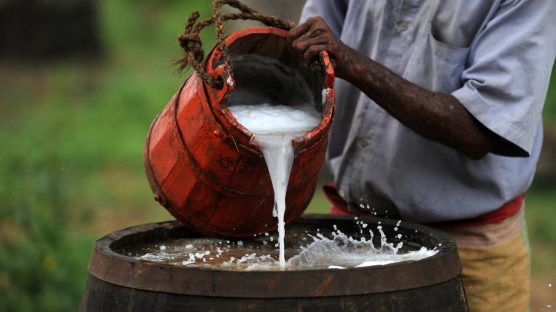
This natural alcoholic drink could be sweet or sour depending on how fresh it is as well as the tree it was sourced from. Palm wine is obtained from the sap sourced from the highest part of the tree when tapped by professional palm wine tappers. With the yeast present in the tapped wine, it is left to ferment in the air which takes approximately two hours. When that is done, it is best to sell or consume soon because the longer it gets the higher the alcoholic nature of the palm wine coming strongly.
In many cultures, palm wine has acquired significant relevance in that it makes a way in African art forms. The intention on how the produce of palm tree is used is largely due to spiritual attribution mated to the palm tree as various parts of the tree are used for ritual practices.
Palm wine is known by different names in different parts of the world. In West Africa’s Ghana, it is called dok, or yabra; in the Eastern part of Indonesia, it is called saguer or tuak. Bringing it back home to Nigeria, it is adorned with varying nomenclature nkwu enu,nkwu ocha and oguro to detail a few. Palm wine has also been beckoned on as a great source of yeast to maintain great eyesight.
In some parts of Africa, like the Western and Central parts, palm wine has a significant function in the communal structure and the order of the community.
In countries like Cameroon, a portion of the palm wine is to be given to the office chief which significantly is a ritual act of paying allegiance and reverence.
Palm wine also makes an important presence for the most part at wedding ceremonies and traditional events.
Before the traditional wedding ceremonies of certain ethnic groups in Nigeria are approved, jars of freshly brewed palm wine (ngwo) are one of the expected requirements the groom’s family gives his prospective in-laws. For instance, the wine is given to an Igbo bride to confirm who her husband is.
In countries like Nigeria, Cameroon, and Sierra Leone, the couple and guests proceeds to dance to palm wine music, also known as highlife music. There is a social life around this natural brew indeed that affects the craft of African melody.
