
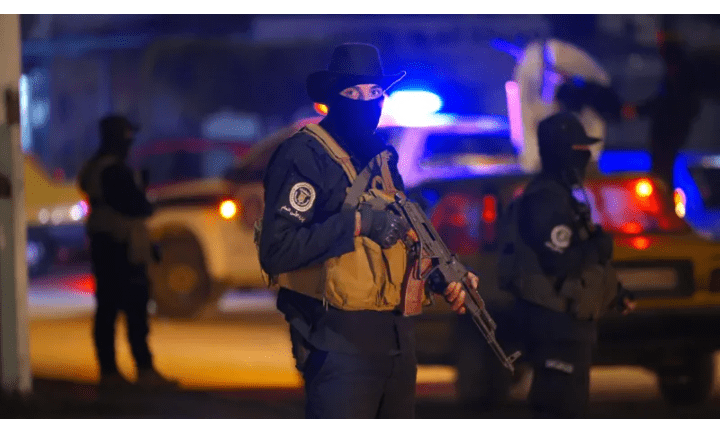
Syrian Forces Oversaw Sectarian Killings Of Alawites, Accused Man Claims.
A man accused of participating in a wave of sectarian violence against Syria’s Alawite minority has claimed that government security forces advised and monitored armed civilians during the deadly attacks in March. The revelation comes as Syria’s new Sunni Islamist-led government grapples with the fallout of the killings, which left nearly 900 civilians dead, predominantly Alawites, in the country’s coastal region.
Abu Khalid, now in custody, told the BBC he travelled to the Alawite village of Sanobar on 7 March as a civilian fighter to combat insurgents loyal to former President Bashar al-Assad. He claimed the General Security department instructed his group to target only armed insurgents and avoid harming civilians. “There were eight men with me, but it was a large group, and the General Security department was overseeing things so that no-one would vandalise the village or harm the residents,” he said.

However, Abu Khalid later filmed himself shooting dead Mahmoud Yusef Mohammed, a 64-year-old Sanobar resident, outside his home. He insisted Mahmoud was an armed insurgent, but the video, verified by the BBC, shows no evidence of a weapon. A former British special forces member confirmed Mahmoud was unarmed, contradicting Abu Khalid’s account. Military police have denied any coordination with Abu Khalid, stating he acted independently and should have captured, not killed, his target.
The violence erupted after insurgents loyal to Assad, an Alawite, launched deadly raids on government security forces on 6 March. The government’s call for support from militia groups and allied fighters escalated into a wave of sectarian retribution against Alawite civilians. Human rights groups report that 889 civilians, including 114 children and women, were killed by pro-government forces in early March. In Sanobar alone, some 200 residents were massacred, with a mass grave now marking the village’s tragedy.
Survivors described harrowing scenes of summary executions and looting by armed groups, some wearing green uniforms and masks. One woman recounted how gunmen killed her father and brother despite their civilian IDs, branding them “Alawite pigs.” Mahmoud’s family, hiding nearby, were too terrified to retrieve his body for three days as armed groups roamed the village.
The Alawite sect, an offshoot of Shia Islam, constitutes about 10% of Syria’s majority-Sunni population. The coastal region, a former regime stronghold, remains tense, with tens of thousands displaced, according to the UN. Amnesty International has labelled the attacks “deliberate” and “unlawful,” calling for investigations into the role of government forces, whose vehicles and uniforms appear in videos of alleged violations.
General Security Forces commander Mustafa Kunaifati admitted “individual cases” of misconduct by his units but insisted those responsible were arrested. Witnesses confirmed his forces protected some villagers, including Mahmoud’s family, who were evacuated shortly before his death. However, Turkish-backed militias and jihadist fighters, now loosely under government control, have been implicated in the killings, with their graffiti still visible in Sanobar.
President Ahmed al-Sharaa, whose Hayat Tahrir al-Sham (HTS) group ousted Assad last year, has vowed to hold perpetrators accountable. A special committee is investigating the violence, with around 30 arrests made. Sharaa’s government, facing the challenge of controlling its armed allies, has promised tolerance and inclusion, but the presence of hard-line factions at checkpoints raises doubts among Alawite villagers, who want only government forces to police their communities.
The killings have exposed deep sectarian fault-lines, with Alawites viewed by some as complicit in Assad’s repressive regime. As Syria’s new government seeks to secure the country and protect minorities, the tragedy of Sanobar serves as a critical test. Other minorities—Druze, Christians, and Kurds—are watching closely to see if the government can unite a fractured nation without repeating the repression of the past.
