
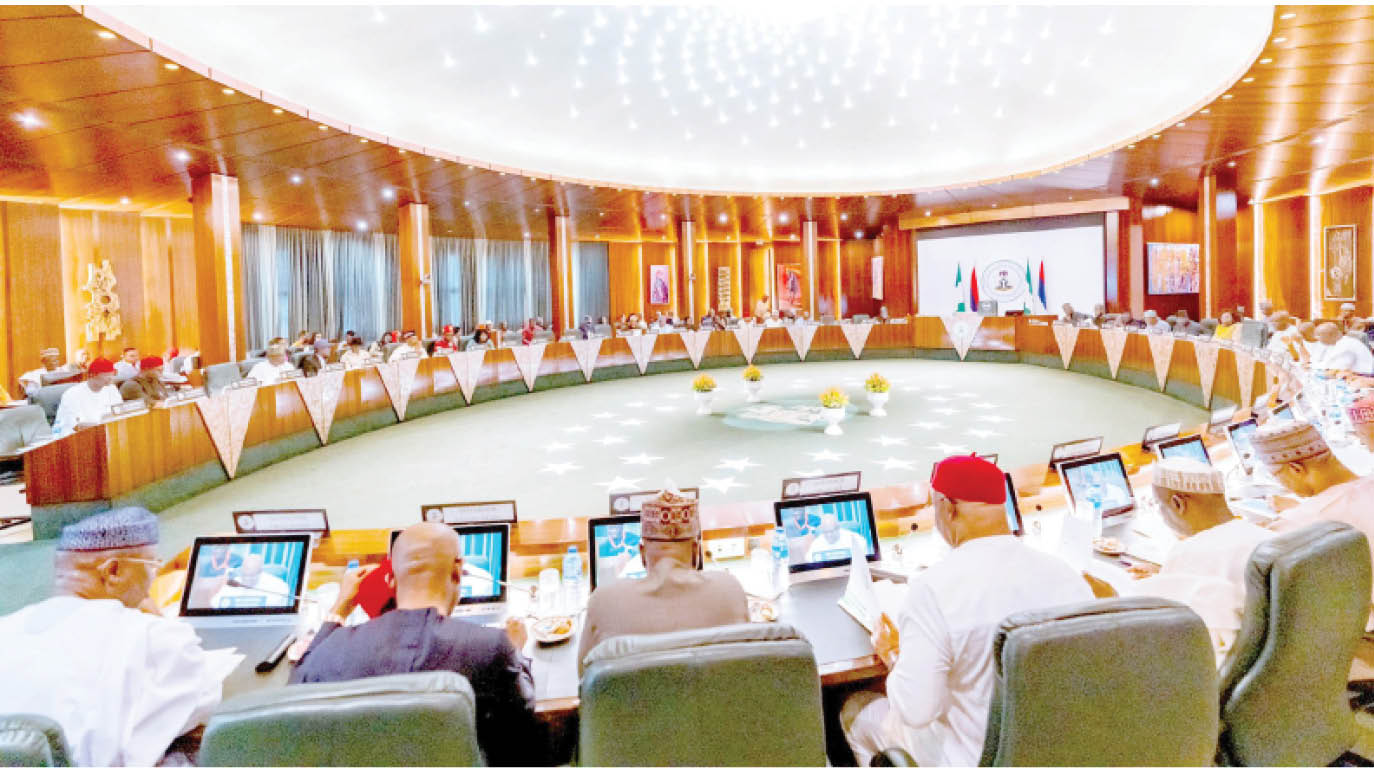
At a recent National Economic Council (NEC) meeting, President Bola Ahmed Tinubu and the governors of Nigeria’s 36 states did not address the pressing issue of the minimum wage.
This omission disappointed millions of Nigerians and members of organised labor, who had anticipated a resolution since the removal of the fuel subsidy on May 29, 2023, the day Tinubu assumed office, and the expiration of the N30,000 minimum wage set in 2019.
The NEC meeting, chaired by Vice President Kashim Shettima and attended by President Tinubu, raised hopes that the new minimum wage threshold would be settled. The 37-member Tripartite Committee on National Minimum Wage, led by former Head of Service Bukar Aji, had already submitted its report to President Tinubu weeks ago after five months of deliberation.
In his Democracy Day speech on June 12, 2024, President Tinubu claimed a consensus had been reached and a proposal would be submitted to the National Assembly.

However, organized labor countered this, stating they were unaware of any agreement. The Nigeria Governors’ Forum (NGF) also rejected the proposed N62,000 minimum wage, arguing that some states would need to borrow funds to meet this amount. Currently, the Nigerian Labour Congress (NLC) and the Trade Union Congress (TUC) are demanding a minimum wage of N250,000.
On Tuesday, the Federal Executive Council (FEC) postponed discussions on the new minimum wage to allow further consultations with stakeholders, including local governments, states, the federal government, and the private sector, as stated by the Minister of Information and National Orientation, Mohammed Idris.
Following the NEC meeting at the Presidential Villa in Abuja, there was no mention of the minimum wage, and governors who briefed the press did not entertain questions on the matter. Instead, President Tinubu approved a ‘one-off’ allocation of N10 billion to states and the Federal Capital Territory (FCT) for the procurement of buses and a CNG uplift programme.
This initiative is part of the new “National Construction and Household Support Programme.”
Presidential spokesman Ajuri Ngelale announced that the programme includes N50,000 uplift grants to 100,000 families per state for three months and provisions for labour unions and civil society organizations. Additionally, N155 billion will be deployed for the purchase and distribution of assorted foodstuffs nationwide.
The program aims to boost agricultural productivity, strengthen the economy by creating opportunities in agriculture, manufacturing, and construction, and provide urgent economic relief for Nigerians. Priority will be given to road infrastructure projects such as the Lagos-Calabar Coastal Highway and the Trans-Saharan Highway.
President Tinubu also approved full counterpart financing for the Port Harcourt-Maiduguri Railway and the Ibadan-Abuja segment of the Lagos-Kano Standard-Gauge Railway. The Sokoto-Badagry road project is also prioritised for its agricultural significance.
During the NEC meeting, President Tinubu urged the governors to collaborate to meet citizens’ needs, promising necessary support to alleviate hardship. He emphasised the importance of producing high-quality food for consumption, trade, and export, stating, “We must produce the food our people eat, and it will require coordination and intentionality between members of the NEC.”
The governors, after a separate meeting, agreed to continue engaging with key stakeholders to reach a mutually agreeable solution on the minimum wage. They assured Nigerians and organized labor that a better minimum wage would result from ongoing negotiations.
In a similar NEC meeting in August 2023, the federal government approved a N5 billion grant for each state for grain procurement and five trucks of rice per state as palliatives for the fuel subsidy removal. Despite this, there were public outcries in many states over the inadequate distribution of these palliatives.
Public commentator Hon. Ikenna Azomchine, speaking on Trust TV’s Daily Politics Programme, criticised the federal government’s approach to mitigating Nigerians’ suffering, stating that palliatives alone would not solve the issues of hunger and insecurity. He urged the Tinubu administration to develop deliberate policies to address these problems.
