
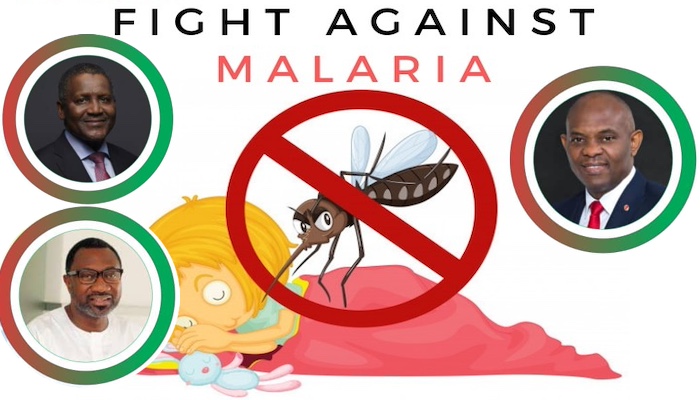
The federal government has launched a new initiative to combat malaria, appointing prominent business leaders Aliko Dangote, Femi Otedola, and Tony Elumelu to spearhead efforts to eliminate the disease.
The decision comes as Nigeria faces a significant malaria crisis, contributing over a quarter of global cases and about a third of the more than 600,000 malaria deaths worldwide, particularly impacting children and pregnant women.
During the inauguration of the team in Abuja, Minister of State for Health and Social Welfare, Dr. Tunji Alausa, highlighted the dire situation, noting that malaria is responsible for 25-30% of childhood mortality and about 60% of hospital visits in the country.
He also emphasised that the disease is a major cause of absenteeism in schools, markets, and workplaces, and represents a significant out-of-pocket expense for many Nigerian households.

Aliko Dangote, Chairman of the Dangote Group, will lead the Nigeria End Malaria Council (NEMC), alongside Femi Otedola, Chairman of FBN Holdings Plc and Geregu Power Plc, and Tony Elumelu, Chairman of UBA Group and founder of Heirs Holdings. Other members of the council include John Cardinal Onaiyekan.
The council will work in collaboration with the Nigerian Governors’ Forum (NGF), National Assembly joint Health Committees, and women’s organizations to drive the anti-malaria efforts.
Dr. Alausa stated that the objective of the council is to reduce the malaria burden and ultimately eliminate the disease in Nigeria, which he believes will lead to an improvement in the quality of life for all Nigerians.
He acknowledged that Nigeria, with its population of over 200 million, remains entirely at risk of malaria, posing a significant challenge to the government.
He pointed out that the current interventions, such as the provision of antimalarial medicines, protective treatments, treated nets, and insecticides, have not been sufficient to cover the targeted population. The bulk of the support for these interventions is donor-driven, which he argued is inadequate and unsustainable.
“While malaria cases and deaths are declining in other countries, Nigeria has continued to record higher numbers. No country has ever eliminated malaria solely through donor support,” Alausa noted, referencing the African Leaders Malaria Alliance (ALMA) launched during the African Union Summit of 2009 and the subsequent Malaria Scorecard developed in 2011 to monitor progress.
The council, originally established in 2017 and inaugurated by former President Muhammadu Buhari in 2022, is tasked with advocating for malaria to remain a high priority on national and state agendas, mobilising financial and in-kind resources from new sources, including the private sector, to address funding gaps in the national malaria strategic plan.
Accepting his role, Dangote, who has previously served as Nigeria’s Malaria Ambassador and a member of the Global End Malaria Council, called for a collective effort to tackle malaria head-on. He highlighted the council’s ability to mobilise resources across sectors, including government, civil society, religion, and business, and stressed the need for strong political commitment and sustained funding.
“Nigeria accounts for a significant portion of the global malaria burden and about 32% of global malaria deaths. It is unacceptable to leave malaria elimination solely in the hands of partnerships and donors,” Dangote said. He also expressed his intention to approach other corporate entities to raise funds for the fight against malaria, drawing parallels to the mobilisation efforts during the COVID-19 pandemic.
Dangote outlined the council’s objectives to ensure malaria elimination remains a national priority and advocated for maintaining the progress made so far. He emphasised the importance of securing sufficient funding and building political will at all levels to ensure Nigeria is on an irreversible path to ending malaria.
“I am glad to join hands with you to reduce the burden and deaths due to malaria in Nigeria,” Dangote added, urging council members to fulfil their responsibilities in protecting and sustaining the progress achieved.
The council members are expected to mobilise the necessary funds and resources to help eradicate malaria in Nigeria. The Nigeria End Malaria Council Secretariat, led by Executive Secretary Mr. Ope Abegunde, was formally handed over to the council to support these efforts.
