
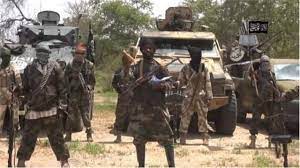
Terrorist activity in Nigeria fell to its lowest since 2011, according to the 2023 Global Terrorism Index (GTI) report released on Tuesday, March 14.
The insurgency of Boko Haram and its deadlier faction, the Islamic State West Africa Province (ISWAP), has killed thousands of Nigerians in the northeast region since 2009, but the groups were more restrained in 2022.
The total number of deaths linked to terrorism in Nigeria dropped from 497 in 2021 to 385 last year. The number of terrorist attacks also dropped from 214 in 2021 to 120, the lowest recorded since 2011.
“Deaths in Nigeria peaked in 2014 at 2,101 deaths before declining in five of the subsequent nine years,” the report noted.

The fall in terrorism puts Nigeria eighth on the list of the most terrorised countries globally in 2022, dropping from sixth in 2021. The country ranked fourth most terrorised in the world between 2017 and 2020, and second in 2016 and 2015 when Muhammadu Buhari took over as democratic president.
Despite the uplifting outlook on Nigeria’s war against terrorism, five of the deadliest terror attacks across the world last year happened in the country.
The deadliest one took place in Borno State where ISWAP killed at least 50 civilians the group accused of reporting their movements to security forces. It was the 11th deadliest terror attack anywhere in the world.
Three of the other four attacks also happened in Borno, where 60% of all terror-related attacks in Nigeria took place in 2022. The fifth deadliest attack, which claimed 20 lives, took place in Kaduna State.
ISWAP is still considered the greatest terror threat to Nigerians, and the group caused 211 deaths in 2022, its lowest in two years.
Despite the drop, the group’s lethality also rose for the first time in two years from just over three deaths per attack in 2021 to almost 3.6 deaths per attack last year.
The main Boko Haram has declined over the years and its attacks dropped by half in 2022, but the group was still responsible for 72 deaths.
“This is the lowest number of attacks by the group for over a decade,” the GTI report noted.
The other group held responsible for terrorism in Nigeria is the Indigenous People of Biafra (IPOB), a separatist group in the southeast region. The Nigerian government branded the group a terrorist organisation in 2017 despite its protestations that it only wants the region to peacefully split from Nigeria.
“They were responsible for 40 attacks and 57 deaths in 2022, an increase from 26 attacks and 34 deaths the year prior,” the report noted.
Globally, terror attacks dropped by 28% and deaths dropped by 9% in 2022, but the attacks became more deadly. An average of 1.7 people died per attack last year compared to 1.3 deaths per attack in 2021.
Afghanistan remained the most terrorised country in the world for the fourth year running since it moved into the top spot in 2019.
Despite the significant drop in terror activities in Nigeria and Niger, the Sahel region was the most affected by terrorism in 2022. The region comprises parts of both countries as well as parts of Burkina Faso, Cameroon, Chad, Gambia, Guinea, Mali, Mauritania, and Senegal.
Deaths in the Sahel constituted 43% of the global total in 2022, compared to just 1% in 2007,” the report noted.
Nigeria finished behind Burkina Faso, Somalia and Mali who ranked first, second and third respectively on the list of the most terrorised countries in Sub-Saharan Africa. Globally, they ranked second, third and fourth respectively.
The GTI uses TerrorismTracker, a database that tracks every terrorist incident reported in open sources, to compile its annual reports, produced by the Institute for Economics and Peace (IEP).
