
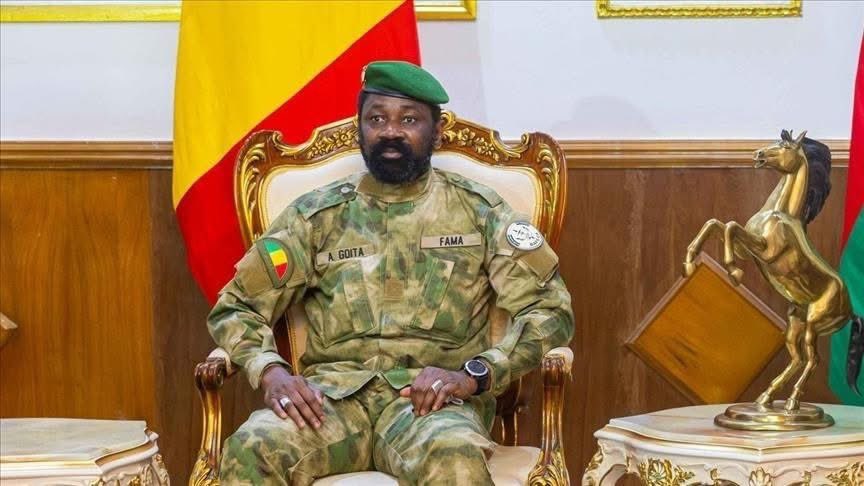
Mali’s Junta Leader Secures Renewable Five-Year Term Without Election.
Mali’s military-appointed legislative body, the National Transitional Council (NTC), has granted General Assimi Goïta, the country’s junta leader, a five-year presidential term, renewable “as many times as necessary” without the need for elections. The decision, made on Thursday, 3 July 2025, paves the way for Goïta to remain in power until at least 2030, despite earlier promises by the military government to restore civilian rule by March 2024. The move has sparked concerns about the erosion of democratic processes in the West African nation, which has been under military control since back-to-back coups in 2020 and 2021.

The bill, unanimously backed by the 131 members present in the 147-member NTC, awaits formal approval by Goïta himself, a formality given his leadership of the junta. The legislation, adopted by the Council of Ministers last month, revises the Transition Charter to grant Goïta a renewable five-year mandate starting in 2025, with the term extendable until the country achieves “pacification.” Malick Diaw, president of the NTC, hailed the decision as “a major step forward in the rebuilding of Mali,” claiming it aligns with the “popular will.” However, the move has drawn criticism from opposition groups and human rights organisations, who view it as a consolidation of military power amid a crackdown on dissent.
Goïta, who first seized power in August 2020 by overthrowing President Ibrahim Boubacar Keïta following mass protests, staged a second coup in May 2021 to solidify his control. Initially, he pledged to hold elections within 18 months, but these commitments were repeatedly delayed, with the junta citing ongoing jihadist violence and technical issues. In April 2025, a national conference, boycotted by major opposition parties, recommended extending Goïta’s presidency until 2030 and dissolving political parties, a decision formalised in May. The NTC’s latest vote further entrenches these measures, allowing Goïta and other junta members to stand in future elections, should they occur.

Mali’s political landscape has grown increasingly restrictive under Goïta’s rule. The junta has banned political parties and prohibited their members from holding meetings, citing “public order” concerns. Pro-democracy protests in Bamako on 3 and 4 May 2025 were met with arrests, with reports of opposition leaders being forcibly disappeared by unidentified armed men. Human Rights Watch condemned the clampdown, noting that the dissolution of political parties violates Mali’s constitution and international human rights obligations. Opposition figures, including former Prime Minister Moussa Mara, have described the measures as a “severe blow” to reconciliation efforts and a direct attack on Mali’s hard-won democratic gains since 1991.
The junta’s actions mirror similar moves in neighbouring Burkina Faso and Niger, where military leaders have also extended their rule and suspended political activities. The three nations, now part of the Alliance of Sahel States (AES), have distanced themselves from former colonial power France, forging closer ties with Russia. Goïta’s supporters argue that his leadership is necessary to combat jihadist insurgencies linked to al-Qaeda and Islamic State, which have plagued Mali since 2012. The capture of Kidal in August 2023 was cited as a significant victory, though critics, including rights groups, point to reports of extrajudicial killings by Malian forces and Russian mercenaries targeting ethnic groups like the Fulani and Dogon.
While some Malians express support for Goïta’s focus on security and independence from Western influence, others fear the entrenchment of authoritarian rule. “Suppressing the multi-party system is a historic error,” said opposition leader Mohamed Salia Touré, echoing sentiments of growing frustration among pro-democracy activists. As Mali grapples with ongoing violence and economic challenges, the NTC’s decision signals a prolonged military grip on power, raising questions about the country’s democratic future.
