
Lagos’ Food Security Woes: Over 75% Of Supplies Still Imported Despite Farmer Training.
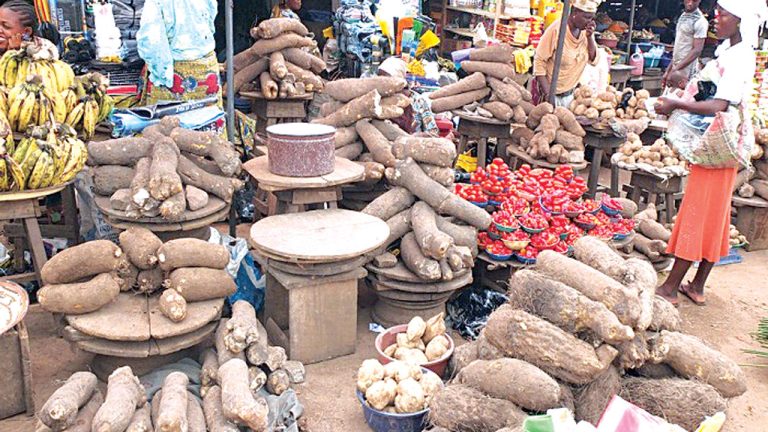
Despite training over 100,000 farmers and fishermen in modern agricultural practices, Lagos State remains alarmingly dependent on other states for more than 75 per cent of its food supply. This troubling revelation, announced by Abiola Olusanya, the Commissioner for Agriculture and Food Systems, casts a shadow over the state’s efforts to achieve food self-sufficiency.
Speaking at a media briefing marking the second year of Governor Babajide Sanwo-Olu’s second term, Olusanya attempted to paint a rosy picture of the state’s agricultural progress. She claimed that training programmes had “significantly boosted productivity” and improved livelihoods over the past year. Yet, the stark reality—that Lagos, Nigeria’s economic powerhouse, relies so heavily on external food sources—raises serious questions about the effectiveness of these initiatives.

Olusanya highlighted the Ministry’s urban farming schemes and grants provided through the State Employment Trust Fund to support agro-entrepreneurship. The Agric Innovation Club, she added, has engaged young minds, offering grants of up to N100 million to 26 agro-innovators. But these efforts, while commendable on paper, seem woefully insufficient when three-quarters of the state’s food still comes from elsewhere. What good is innovation if it fails to address such a fundamental dependency?
The commissioner also touted the near-completion of a central food system and logistics hub in Epe, which she claimed would propel Lagos’ food value chain to a N14 trillion market. This ambitious projection feels more like a distant dream than a realistic solution, especially given the state’s inability to reduce its reliance on external suppliers. Without tangible progress in local production, such grand infrastructure projects risk becoming little more than expensive symbols of unmet potential.
Ekiti’s Livestock Ambitions: A Familiar Tale of Big Promises
Meanwhile, in Ekiti State, the government’s Livestock Productivity and Resilience Enhancement Project (L-PRES) promises to train 200,000 farmers and create 1.5 million jobs through commercial livestock production. Commissioner for Agriculture and Food Security, Boluwade Ebenezer, outlined plans to focus on dairy/beef, sheep/goat, piggery, and poultry value chains during a recent training workshop. Yet, such lofty goals invite scepticism, particularly when Lagos’ experience shows that training alone does not guarantee self-sufficiency.
Represented by Permanent Secretary Ebenezer Babatope Ojo, Boluwade called for collaboration among stakeholders to ensure sustainable food security. Olayinka Adedipe, the L-PRES Project Coordinator, noted the project’s reach across 16 local councils, while Prof. Ogunlola James of Synergy Impact Consultant Limited hailed the shift towards livestock production as a novel move. But without addressing systemic issues like market access, infrastructure, and funding gaps, Ekiti’s plans may follow Lagos’ path: heavy on rhetoric, light on results.
A Sobering Reality Check
Lagos’ persistent dependence on other states for most of its food commodities is a sobering indictment of its agricultural strategy. While training programmes and innovation hubs sound promising, they have yet to deliver the transformative change needed to feed Nigeria’s most populous state.
Ekiti’s ambitions, though well-intentioned, risk falling into the same trap unless backed by robust, practical measures. For now, both states serve as stark reminders that bold promises and glossy initiatives cannot mask the harsh truth: Nigeria’s urban centres remain at the mercy of external food supplies, with no clear path to self-reliance in sight.
