
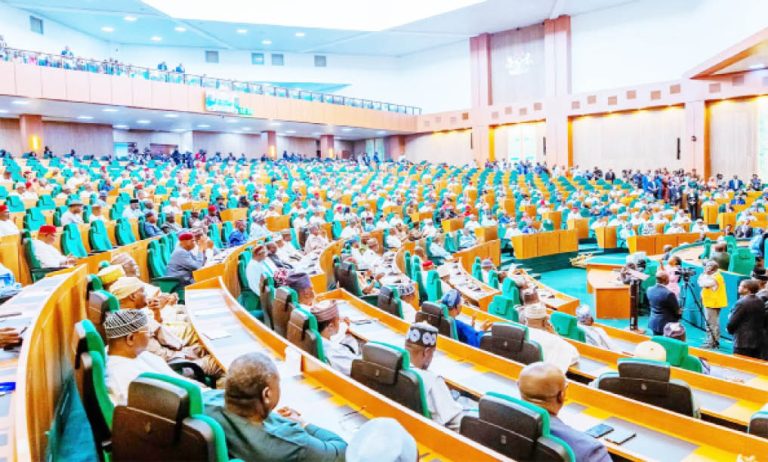
House Of Representatives Rejects Bill On Rotational Presidency Across Nigeria’s Six Geopolitical Zones.
Nigeria’s House of Representatives has voted down a constitutional amendment bill that sought to mandate the rotation of the presidency and vice presidency among the country’s six geopolitical zones. The decision, made during a plenary session on Tuesday, has sparked widespread debate about political representation and national unity.
The bill, formally titled A Bill for an Act to Alter the Constitution of the Federal Republic of Nigeria, 1999, to Provide for the Principle of Rotation of the Offices of the President and Vice President among the Six Geopolitical Zones, aimed to ensure equitable distribution of the nation’s highest offices across the North Central, North East, North West, South East, South South, and South West zones. Proponents argued that such a system would foster inclusivity and address longstanding regional imbalances in political power.

However, the bill failed to garner sufficient support to pass its second reading. Lawmakers expressed varied concerns, with some cautioning against embedding such a policy in the constitution. Olumide Osoba, a representative from Ogun State (APC), argued that while the idea was novel, it could unduly restrict political parties’ freedom to select candidates based on merit. “We should not engage in a dangerous precedent by putting it in the Constitution,” Osoba stated, highlighting the risk of forcing parties to adhere to a rigid zonal formula.
On the other hand, Minority Whip Ali Isa advocated for the bill, suggesting that rotational presidency would ensure fairness and give all regions a chance to lead. He further proposed extending the principle to state levels, where governorships could rotate among senatorial zones to promote inclusivity.
The rejection of the bill was accompanied by the dismissal of six other constitutional amendment proposals listed on the House’s order paper. These included measures to transfer the registration and regulation of political parties from the Independent National Electoral Commission (INEC) to the Office of the Registrar General of Political Parties, among others.
The decision has elicited mixed reactions across Nigeria. Supporters of the rotational presidency bill expressed disappointment, arguing that it could have strengthened national cohesion. Critics, however, hailed the outcome, warning that constitutionalising such a policy might deepen regional divisions or undermine democratic choice.
Posts on X reflected the polarized sentiment, with some users describing the rejection as a setback for equitable representation, while others praised the House for prioritizing flexibility in candidate selection. The debate underscores the complexity of balancing regional interests with national unity in Nigeria’s diverse federation.
As the nation digests this outcome, analysts anticipate further discussions on how best to address regional representation within Nigeria’s political framework. For now, the rejection of the bill maintains the status quo, leaving the selection of presidential and vice-presidential candidates open to political parties’ discretion.
