
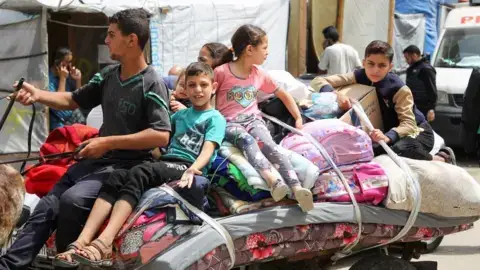
Israel has told tens of thousands more Palestinians to leave Rafah, as it intensifies military operations in southern Gaza.
Flyers dropped from the air and posts on social media told residents in the city’s eastern districts to go to al-Mawasi – a narrow coastal area which Israel calls an “expanded humanitarian zone”.
Parts of Rafah where the streets were packed with locals and displaced people just days ago, now look like a ghost town.

Israel has said it will proceed with planned operations in Rafah despite the US and other allies warning that a ground offensive could lead to mass civilian casualties and a humanitarian crisis.
Images showed smoke rising over the city on Saturday and witnesses quoted by AFP reported air strikes near the crossing with Egypt.
Posting on X, formerly Twitter, the Israel Defense Forces (IDF) said that during the past day troops had been engaged in “face-to-face battles” with Hamas fighters in Rafah.
The IDF added that soldiers had found “a number of underground shafts” in the area.
In the past day, there have been dozens of Israeli air strikes across the length of the Gaza Strip, with the Israeli military saying it’s targeting what it calls terrorists and terrorist infrastructure.
It also instructed residents to leave some areas of northern Gaza, indicating its forces may return there months after they previously left.
The IDF said people in and around Jabaliya, in northern Gaza, need to “temporarily evacuate to shelters in western Gaza City” in order to “reduce harm” to residents “following attempts by Hamas to reassemble” in the area.
Israel’s plans to extend its ground offensive to the southern tip of the Gaza Strip – where hundreds of thousands of Palestinians have sought refuge from fighting elsewhere in the territory, has sparked international concern.
Last week, President Joe Biden said the US would not supply heavy weapons to Israel which could be used in a major assault on Rafah.
In an interview with CNN, Biden said America would continue to give Israel the weapons it needed to defend itself, including interceptors for its “Iron Dome” air defence system.
But he said US-supplied heavy weapons had already killed civilians in Gaza, and warned Israel would not keep Washington’s support if it carried out military operations in those population centres.
UK Foreign Secretary David Cameron has said Britain is opposed to the military operation in Rafah, but is unlikely to follow America in delaying arms sales to Israel.
On Friday, Israeli Prime Minister Benjamin Netanyahu said he hopes to overcome his differences with Mr Biden – but vowed to press ahead with its military assault on Rafah.
“If we need to… we will stand alone. I have said that if necessary we will fight with our fingernails,” Mr Netanyahu said.
Saturday’s evacuation order came hours after a US state department report said Israel may have used American-supplied weapons in breach of international humanitarian law in some instances during the war in Gaza.
It is “reasonable to assess” that those arms have been used in ways “inconsistent” with Israel’s obligations, the report said, but added the US did not have complete information in its assessment and that shipments could continue.
Aid agencies have warned that the continuing Israeli military operation in southern Gaza means Palestinians will be left without any places of safety.
Khitam Al-Khatib, a Rafah resident who said she had lost at least 10 of her relatives in an airstrike on a family house earlier on Saturday, told Reuters there was “no safe place in Gaza”.
“They threw fliers on Rafah and said, from Rafah to al-Zawayda is safe, people should evacuate there, and they did, and what has become of them? Dismembered bodies?” she was quoted as saying.
The charity Oxfam has said that the area has no functioning hospitals and aid supplies are extremely limited.
The largest of Rafah’s three partially functioning hospitals, Abu Youssef al-Najjar, had to be hastily abandoned the following day after staff received an evacuation order and there was fighting nearby.
The UN’s agency for Palestinian refugees has also expressed concerns about the conditions in the al-Mawasi encampment where people are being told to go.
Sam Rose from UNRWA told BBC News that the area had virtually no facilities for the numbers being sent there.
“It’s people living in shacks, people living in tents by the side of a sandy beach road. Very difficult here in terms of providing services.
“There’s no water networks there. There’s no unfracture, sewage, sanitation,” he said.
Israel launched a military campaign in Gaza to destroy Hamas in response to the group’s attack on southern Israel on 7 October, during which about 1,200 people were killed and 252 others were taken hostage, according to Israeli authorities.
More than 34,900 people have been killed in Gaza since then, according to the territory’s Hamas-run health ministry.
Israel says 128 hostages are unaccounted for, 36 of whom are presumed dead.
BBC
