
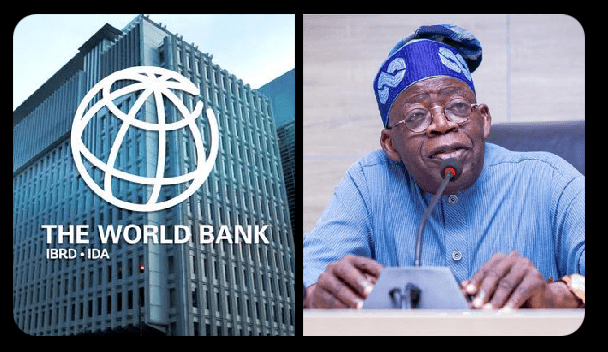
Federal Government And World Bank Partner On $17 Billion Programme To Reduce Poverty In Nigeria.
The Federal Government of Nigeria has forged a renewed partnership with the World Bank aimed at reducing poverty and improving the living standards of the country’s most vulnerable populations. This collaborative effort, valued at over $17 billion, will be channelled through various social investment programmes.
This development was disclosed by the World Bank’s Regional Vice President for Western and Central Africa, Ousmane Diagana, during a high-level meeting in Abuja with Nigeria’s Minister of Humanitarian Affairs and Poverty Reduction, Professor Yilwatda Nentawe, and his Minister of State, Dr Yusuf Sununu.

Diagana highlighted the strategic importance of the partnership, stating that the World Bank’s involvement is designed to support Nigeria’s developmental goals by investing in essential services and job creation initiatives.
“This partnership of the World Bank is anchored in a strategy that allows Nigeria to continue to make progress as a developing country by providing quality services to the people through job creation and others,” he explained. “We have a large programme here in Nigeria of more than $17 billion as a commitment to do what is necessary in terms of investment and reforms.”
Minister Nentawe added that beneficiaries of the Federal Government’s Conditional Cash Transfer scheme will be provided with digital identities, enabling the government to trace and monitor the impact of interventions more effectively.
“This digital identity offers not just social inclusion but also financial inclusion to hundreds of thousands of Nigerians who, before now, were not socially or financially included in Nigeria,” he said.
Meanwhile, the Independent Media and Policy Initiative (IMPI) has responded to recent criticisms of the World Bank loans by Senator Mohammed Ndume, describing his comments as a misrepresentation of facts.
In a statement signed by its Chairman, Dr Omoniyi Akinsiju, the policy group clarified that nearly 80 per cent of Nigeria’s multilateral debt in 2024 was sourced from the World Bank, with total figures rising modestly from $21.15 billion in 2023 to $22.32 billion in 2024 – a 5.5 per cent increase. This contrasts sharply with Senator Ndume’s claim of a $9.5 billion increase.
Furthermore, IMPI pointed out that Nigeria’s debt to the International Monetary Fund (IMF) actually fell significantly, dropping from $2.47 billion to $800.23 million over the same period – a 67.6 per cent reduction.
The group emphasised that the Tinubu administration has not been recklessly accumulating debt but has instead adopted a strategic and balanced approach to credit acquisition, focusing on critical sectors of the economy while gradually reducing overall debt.
Addressing concerns about transparency, IMPI also clarified that all World Bank loans undergo a rigorous approval process. “The World Bank credit approval process requires authorisation by its internal arms (IDA or IBRD) and subsequent concurrence by Nigeria’s National Assembly before any disbursement,” the group stated.
It added that while six projects worth $4.25 billion were approved by the World Bank in 2024, only $2.36 billion has been disbursed so far – a figure far below what Senator Ndume claimed.
IMPI concluded by urging public officials to prioritise accuracy and transparency in their engagements, warning against the spread of misinformation for political gain.
