
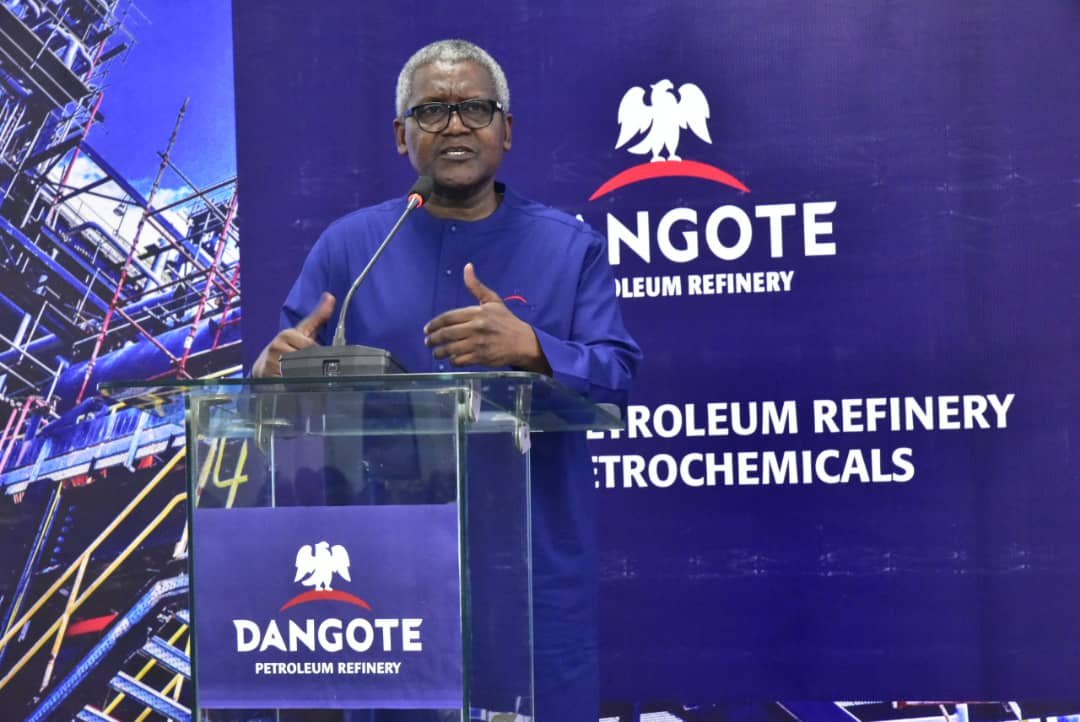
Alhaji Aliko Dangote, Africa’s richest man, has expressed his willingness to transfer ownership of the multibillion-dollar Dangote refinery to the Nigerian National Petroleum Company Limited (NNPCL) following escalating disputes with regulatory authorities in Nigeria’s oil and gas sector.
Over the weekend, many Nigerians voiced concerns about the ongoing conflict between the Dangote Group and regulatory bodies, particularly over the operations of the Dangote refinery. Dangote has accused both local and foreign interests, which he described as a “mafia,” of attempting to hinder the completion of his refinery.
In recent developments, the Nigerian Midstream and Downstream Petroleum Regulatory Authority (NMDPRA) claimed that the Dangote Refinery was producing diesel with a sulphur content of 665 parts per million (ppm), which they deemed inferior to imported products. Farouk Ahmed, CEO of NMDPRA, stated that the refinery had not been licenced to commence operations in Nigeria and warned against relying on it for fuel supply.
Dangote, in an exclusive interview with PREMIUM TIMES, challenged the NNPCL to buy him out. “Let them buy me out and run the refinery the best way they can. They have labelled me a monopolist. That’s an incorrect and unfair allegation, but it’s OK. If they buy me out, at least, their so-called monopolist would be out of the way,” he said.

The 650,000 barrel-per-day Dangote refinery, commissioned last year at a cost of $19 billion, was expected to reduce Nigeria’s dependence on imported petroleum products, potentially saving the country about 30% of its foreign exchange expenditure on imports.
The House of Representatives has summoned the NMDPRA boss to address the contentious issues surrounding the Dangote refinery and to clarify the federal government’s stance. Economic experts and stakeholders have called for the government to support domestic refineries like Dangote’s, citing the potential economic benefits.
Efforts to get comments from President Bola Tinubu’s advisors on the matter were unsuccessful. However, Dangote emphasised the refinery’s role in resolving Nigeria’s fuel crisis, which has persisted since the 1970s. “We have been facing a fuel crisis since the 70s. This refinery can help in resolving the problem but it does appear some people are uncomfortable that I am in the picture. So I am ready to let go, let the NNPC buy me out, and run the refinery,” he said.
Earlier, Devakumar Edwin, Vice President of Oil and Gas at Dangote Industries Limited, accused international oil companies (IOCs) of inflating premium prices to thwart the refinery’s efforts to purchase local crude, forcing it to import crude at higher costs. The Nigerian Upstream Petroleum Regulatory Commission (NUPRC) has intervened to ensure adherence to Domestic Crude Oil Supply Obligations under the Petroleum Industry Act (PIA).
Despite these challenges, the NUPRC and NMDPRA have refuted claims of obstructing the refinery’s operations. NUPRC CEO Gbenga Komolafe and NMDPRA’s Ahmed insisted that regulatory bodies have been supportive of the refinery, with Ahmed alleging that the Dangote refinery sought to halt import licences for other marketers to monopolise fuel supply in Nigeria.
Public reactions have been mixed, with some Nigerians accusing the regulatory bodies of attempting to sabotage the refinery. An economist, Kelvin Emmanuel, argued that the NNPCL, not the IOCs, is responsible for the refinery’s crude supply issues.
In response to quality concerns, Dangote stated that the refinery’s products meet and exceed regulatory standards, inviting regulators to inspect and verify the quality of its products. “In terms of quality, nobody can produce anything better than us. I just got the result from our official 5 minutes ago, we are now down to even 32 ppm,” he said.
Amidst the ongoing disputes, Dangote has called off plans to invest in a new steel plant in Nigeria, citing accusations of seeking a monopoly. Economic analysts have urged the government to support domestic refineries and avoid blame games, emphasising the need to rehabilitate existing government-owned refineries.
Dr. Muda Yusuf, CEO of the Centre for the Promotion of Private Enterprises, highlighted the importance of domestic refining for economic stability. Similarly, Prof. Kingsley Nwokoma of the University of Lagos advocated for the rehabilitation of Nigeria’s refineries to enhance the local market and mitigate monopoly concerns.
