
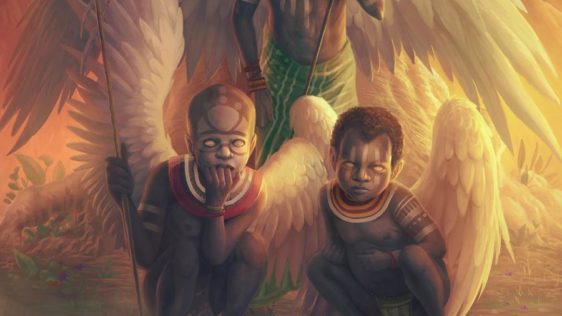
They have existed from time immemorial, in Yorùbá culture and other major cultures in Nigeria and Africa in general.
These are children who are born to die. They are called different names, varying from one tribe or the other. In Yorùbáland they are known as “Àbíkú” which literally means “Born to die” or “Predestined to die”.
The birth of children in the African culture is that spiced up token that brings fulfilment to a marriage, but these children bring pain. Once they are born, there is an expiry tag on their neck. They die before puberty.
These children are believed to belong to a fraternity of demons living in the woods, especially about and within large Iroko trees; and around the trunks of huge silk trees.

Once leave their “Ẹgbé” – a gathering of lost children who live within the Iroko tree – with a sworn promise to return to the fold at a specific time. As joyful as it is to have a child, these children bring untold hardship and pain to their parents and even sometimes repeat the painful process.
Their process of departure into the spirit realm kicks off with a heavy bout of strange sickness and convulsing fits which the babalawo (native medicine man) sees as obvious signs of “Àbíkú”. After days of constant fever and convulsions, they finally give up their physical attachment to the earth and return to their mates in the spirit world.
So, how did the mystery of the “Àbíkú” start? Well, it has been in existence for as long as the Yoruba race has been in history. It was discovered by traditional medicine men who named them thus because of the short life span the Àbíkú possess, and their ability to have recurrent earth lives, which torment their earthly hosts.
Once they die, these children are buried in an evil forest or deep inside a dense forest with lacerations on their body. The reason for the slash or cut is more as a punishment and disgrace – to have them tarnished as they return to their spirit mates, and also to instantly recognise them once they come visiting earth again.
Healing of Abiku Children, 1973. Photo Prince Twins Seven-Seven
Apart from the inflicted punishment marks which give them away when they are re-born, they also bear special and specific names to distinguish them. Names such as: Apara, Dúrósinmí, Bánjókòó, Málọmó, Kòsókó, Òkúand Tijú-ikú.”
But is this phenomenon really true or is the manifestation of the “ÀBÍKÚ” syndrome what one can likely call traits of Sickle cell anemia or any other disease that leads to infant mortality? In pre-colonial times in Yorùbáland and in Africa, there was no technology to test the blood genotype for intending couples. Everything was based on love, family pedigree and the relationships between families.
People were generally ignorant about this medical issue, thus sickle cell anemia may have been very rampant in the past because men and women got hooked with no knowledge of the blood group of their intending spouses.
The traditional medicine men could not have diagnosed a simple biological abnormality with a name that best describes what the child is going through when having crisis; a common situation that sufferers of sickle cell anemia undergo, when their white blood cells can no longer fight infections and protect them.
By the early 60’s, most intending couples still did not check their blood group, and even now in 2020, a couple of cases still go unchecked with proper medical check-couples who elope and ignore all warnings, or in cases of ill-timed pregnancy where abortion was not an option.
In a modern world with increasing technological advancements, is it safe to say that the “ÀBÍKÚ” phenomenon is just an absurd superstition; a simple case of hereditary taint which leads to infant mortality cases; a case of sickle cell anemia?
One thing is sure: professionals from traditional medicine and beliefs practitioners would argue for and against the existence of “ÀBÍKÚS”, while medical doctors would also argue for the fact that if anyone with an AS blood genotype marries a AS, there is a high probability that they would give birth to a child with the SS gene, even though today’s technology now has measures of managing and controlling pre and after birth treatment for sickle cell patients.
There is a thin line between Traditional Medicine/Beliefs and Orthodox Medicine. Àbíkú may just be/may have become that intersection, bringing the much-needed dialogue and balance between science and tradition.
