
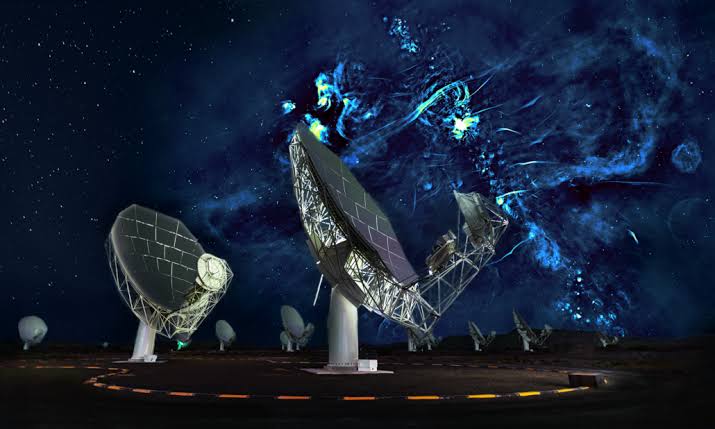
- A massive space program aimed at the exploration of the birth of the universe has commenced in South Africa.
- This project is in partnership with member states across the globe including China, Italy, and more.
- The project is set to be completed in 2030.
Scientists for years now have gazed at the stars and wondered what lies in the vast expanse of outer space. Although to some degree, astronomers have figured out some of the mysteries of the universe, a lot is still yet to be discovered.
While decades of research into this mystery has been instituted in continents containing exorbitant space stations, the quest for understanding the universe may end up being actualized in Africa.
A milestone in this inquisition was celebrated on Monday as the assembling of the world’s largest radio astronomy instrument in South Africa, commenced.

The goal of this project is to build a well-equipped facility that would aid in the discovery of the events of the cosmic dawn, when the first stars and galaxies were born. There is also the goal of discovering the fundamental physics in extreme environments and the origins of life.
The SKAO observatory, an intergovernmental organization composed of Member States from five continents, is in charge of the project. The countries constituting the SKAO observatory includes, Italy, China, Switzerland, Netherlands, South Africa, Australia and the United Kingdom.
Joseph McMullin, deputy director-general at the SKA Observatory (SKAO) intergovernmental organization said, “today has huge significance for all of us … working towards building a large, exploratory instrument that can serve our community and advance a number of scientific frontiers.”
Below are five things to know about the SKAO’s project
Approval and commencement: This project was approved 18 months ago in May 2021. However, the project just commenced this week, owing to complications in contracting professional services firms to help oversee construction, and bulk-buying components such as programmable circuit boards currently in short supply worldwide. The projects would be housed in South Africa and Australia, where key components such as high frequency telescopes and antennas would be mounted.
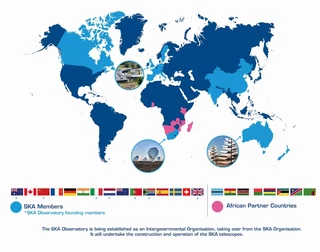
Facility: To discover the mysteries of the cosmic dawn, the SKAO decided that the following systems were necessary, two giant telescopes, 133 SKA dishes, 64 SKA-precursor telescope MeerKAT and a low-frequency array of 131,072 antennas. These two telescopes set to be constructed in South Africa and Australia are touted as two most advanced radio telescopes on Earth. The specific region these telescopes would be placed are the remote town of Carnarvon, Northern Cape, South Africa and the Murchison area of Western Australia inhabited by the Wajarri people.
Budget: In these last 18 months over 40 contracts worth more than €150 million have been entered into by the observatory. During the launch of the program on Monday, some additional new construction contracts worth over €300 million were announced. Taking into account other finances, the current construction budget stands at €500. The parts needed to build the telescopes, equipment and infrastructures would be produced in several SKAO partner countries, including Italy, Spain, and South Africa.
Opportunities for the locals: Seeing as the construction of these instruments would take place in South Africa and Australia, it is only fitting that the indigenes of these regions benefit from such a monumental project. In South Africa the lead infrastructure contractor would provide a range of sub-contract opportunities to local SMMEs, on employing, training and transferring skills locally and on other community development initiatives.
In Australia nearly 100 new roles for the Wajarri Yamaji and locals in the Mid West region of Western Australia. Also the use of these lands would not undermine the local practices of those who inhabit the region. Their cultures would be respected.
Timeline of project: This project according to the SKAO, would be completed in 2030. The first two antenna stations are set to be completed in May 2023. The first dish is set to be installed in April 2024, followed by three to four dishes each month.
