
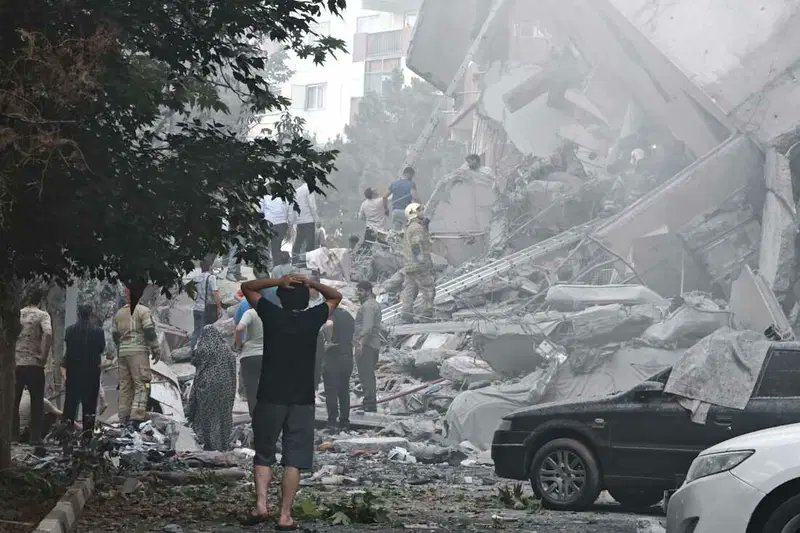
5.1-Magnitude Earthquake Strikes Northern Iran Amid Ongoing Conflict With Israel.
Tehran, Iran – A 5.1-magnitude earthquake struck northern Iran on Friday, 20 June 2025, rattling the region near Semnan as the country grapples with escalating tensions due to its ongoing conflict with Israel. The tremor, which occurred at 9:19 PM local time, was felt across parts of northern Iran, including the capital, Tehran, approximately 150 kilometres away, but caused no reported casualties or significant damage, offering a moment of relief amidst a turbulent period.
According to the United States Geological Survey (USGS), the quake’s epicentre was located 37 kilometres southwest of Semnan city, at a shallow depth of 10 kilometres, which typically increases the potential for surface impact. However, Iran’s official news agency, IRNA, described the damage as “minimal,” with no immediate reports of injuries. Iranian state television reported a slightly higher magnitude of 5.5, noting that the tremor shook the area around Sorkheh in Semnan province. The European-Mediterranean Seismological Centre (EMSC) provided a differing estimate, suggesting a depth of 35 kilometres, but confirmed the quake’s effects were felt widely across northern Iran.

The earthquake comes at a time of heightened alert in Iran, as the nation faces repeated Israeli airstrikes targeting its nuclear and military infrastructure, including sites in Natanz, Isfahan, and Fordo, as part of the ongoing Israel-Iran conflict that intensified on 13 June 2025. Semnan province, near the quake’s epicentre, is home to the Semnan Space Centre and a major missile complex, prompting speculation on social media about a possible link to Iran’s nuclear activities or Israeli military actions. Posts on X reflected public curiosity, with some users theorising about underground nuclear testing, though no evidence supports these claims.
Seismologists, including those from the USGS and the Comprehensive Nuclear-Test-Ban Treaty Organization (CTBTO), have dismissed such speculation, emphasising Iran’s position on the Alpine-Himalayan seismic belt, which makes it one of the world’s most earthquake-prone regions. Iran experiences approximately 2,100 earthquakes annually, with 15 to 16 registering at magnitude 5.0 or higher. Experts noted that the quake’s seismic wave patterns, including both P and S-waves, are consistent with natural tectonic activity rather than nuclear-induced events, which typically produce distinct P-wave patterns.
The timing of the quake, amidst Israel’s campaign to disrupt Iran’s nuclear and missile capabilities, has nonetheless fuelled public concern. Israeli strikes have reportedly caused significant damage to Iran’s military infrastructure, with 639 fatalities reported by the US-based Human Rights Activists News Agency since the conflict escalated. Iran has retaliated with missile and drone attacks on Israel, resulting in at least 24 deaths, according to Al Jazeera’s fact-checking unit, Sanad.
Despite the geopolitical tensions, Iranian authorities quickly mobilised to assess the quake’s impact, with emergency services on standby to monitor for aftershocks. The lack of casualties or major structural damage has been hailed as a fortunate outcome, particularly given the region’s vulnerability to seismic activity. A local resident, Hossein Rezaei, expressed relief: “We felt the ground shake, and with everything happening, we feared the worst”.
The International Atomic Energy Agency (IAEA) Director General, Rafael Grossi, reiterated warnings against targeting nuclear facilities, highlighting the risk of radioactive releases with far-reaching consequences. His statement, made hours before the quake, underscored the need for restraint amid the conflict.
