
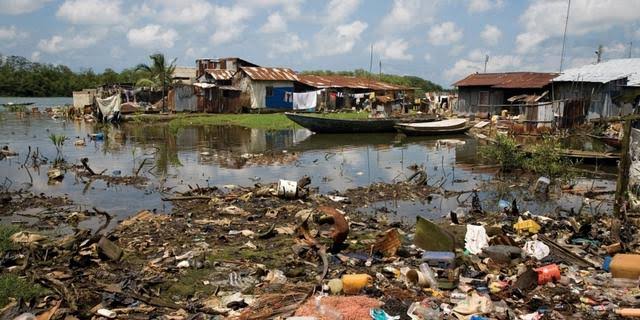
- Govima presents 10 of the worst environmentally degraded countries in Africa.
- This list is courtesy of The Institute for Economics and Peace.
- All ten countries on the list are in Sub-Saharan Africa.
As humanity continues to increase in number, so does the ecological footprint we leave behind, owing to growing levels of consumption.
Consumption is at the very core of ecological degradation. The more humanity needs to satisfy its excesses the more the planet suffers, and the more the social gap between the global community widens. This cycle inadvertently accelerates other predicaments that reprehensibly displaces millions of people all over the world.
A region’s level of environmental degradation is determinant of catastrophic events. In such cases, food and water shortages, conflicts, poverty, malnutrition, forced migration, illness, and natural disasters could be imminent.

As a result, it is important to measure the damage ecological degradation brings about.
Fortunately, on that note, The Institute for Economics and Peace, a global research team focused on measuring the economic value of peace, for the third time released its annual Ecological Threat Report in 2022.
This report analyzes ecological threats in 228 independent states and territories. It also covers over 3,638 sub-national administrative districts, or 99.99 per cent of the world’s population, assessing threats relating to food risk, water risk, rapid population growth and natural disasters.
This latest Ecological report identified 41 countries facing the most extreme food insecurity, 37 of which were Sub-Saharan African countries.
Of the 41 of these nations, 27 are what the report refers to as hotspot countries, and two-thirds of hotspot countries are in Sub-Saharan Africa (SSA). These hotspot countries have catastrophic ecological threats, while also having the lowest levels of societal resilience.
Globally, these hotspot countries are clustered in three regions: SSA, Middle East and North Africa (MENA), and South Asia. These regions are also the three least peaceful as measured by the institute’s Global Peace Index.
To measure each country’s ETR, the Institute for Economics and Peace, evaluated four different threats that directly relate to drivers of conflict, they include, food security, disasters from natural events, water stress and population.
These threats are classified in severity from low to catastrophic. A country is defined as facing a catastrophic threat if it exceeds one or more of the aforementioned thresholds.
Also to create the report, the Institute pulls from its comprehensive, ecological, geospatial and societal database based on 15 years of the Global Peace Index and Positive Peace Index.
Below are ten of the most ecologically degraded countries in Africa, according to the report.
- Burundi
- Central African Republic
- Chad
- Republic of the Congo
- Somalia
- South Sudan
- Uganda
- Angola
- Cameroon
- Democratic Republic of Congo
