
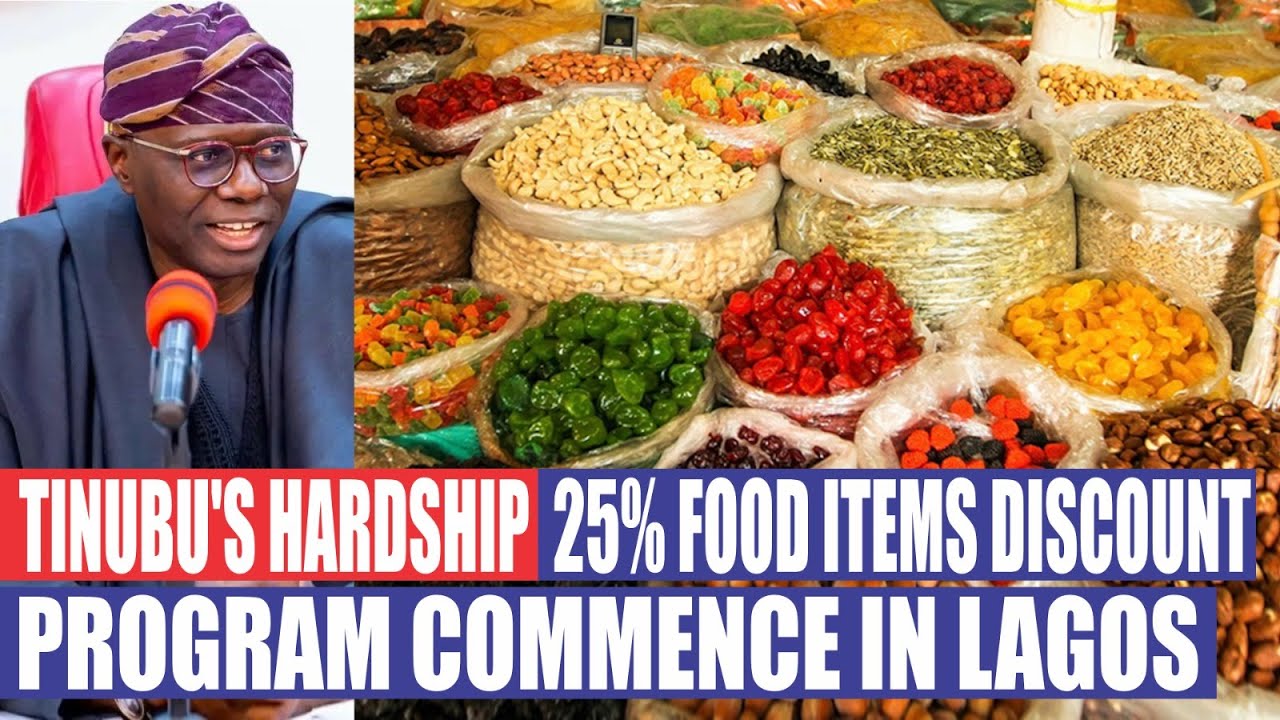
The Lagos State Government has unveiled a 25% subsidy on essential food items as the festive season approaches — a move aimed at easing the cost-of‐living pressures on households.
What The Subsidy Covers
According to Abisola Olusanya, Commissioner for Agriculture and Food Systems, the initiative includes:
-
A 25% discount on staples like 5 kg rice, 3.2 kg beans, 2.5 kg garri, 1 loaf of bread, 1 kg each of pepper and other essentials.

-
Availability of these discounted items at the Lagos Fresh Food Hub, Mushin.
-
Extension of support to farmers via the second phase of the ‘Ounje Eko Farmers’ Subsidy Programme, which includes 25% subsidies on poultry and fish feeds.
Why This Matters
-
With inflation and rising food prices putting pressure on households, especially low‐ and middle‐income families, the subsidy offers direct relief.
-
By simultaneously supporting production (via farmers feed subsidies), and consumption (via discounted staples), the state aims to stabilise supply chains and mitigate price hikes.
-
Lagos State, being Nigeria’s economic hub with high consumption levels and heavy dependence on external food supply, has particular vulnerability to food price shocks. The intervention aligns with broader initiatives such as the Produce for Lagos Programme and a food systems transformation agenda.
Implementation & Impact So Far
-
Over 5,000 farmers reportedly benefited from the first phase of the Ounje Eko programme: distribution of about 1,000 tons of poultry feed and 300 tons of fish feed. That supported roughly 260,000 layer birds, production of over 7 million eggs, and about 177,100 catfish.
-
One tangible effect: egg crate prices dropped from an average of ₦6,000 to ₦5,000, attributed partly to the subsidy interventions.
-
The state emphasises monitoring, competitive off-take, and linking farmers to stable markets to prevent diversion or reuse of subsidy funds inefficiently.
Challenges & Considerations
-
Coverage & Access: Will the discounted items reach all Lagos State residents equitably, especially those in outlying areas and informal settlements? Physical availability and distribution logistics will matter.
-
Sustainability: Subsidies impose fiscal cost and can create dependency; the state will need to manage inflationary risks and ensure that support does not unduly distort markets or reduce incentives for production in the long-run.
-
Monitoring and Implementation Integrity: As with many subsidy initiatives, the risk of diversion, unequal access, or bottlenecks is real. The state’s mention of targeting and monitoring is encouraging but execution will be key.
-
Inflation & External Factors: Food price dynamics are influenced by global supply, exchange rates, fuel costs, logistics, and security of agricultural production. Subsidies help cushion but cannot fully insulate consumers from macro-shocks.
-
Scope and Timing: The festive season surge in demand often leads to sharper price increases and supply shortages. Timely rollout and communication to consumers will determine the effect.
What This Means For Lagos Residents
For many Lagos households, especially those navigating tight budgets, this subsidy means:
-
More affordable access to staples ahead of the holiday season; smaller households or lower‐income families could see a meaningful reduction in food expenditure.
-
Potential stabilisation of prices for key items that often surge as festivities approach.
-
Increased impetus for local farmers and producers to expand output given the state support – possibly translating into longer-term availability and price stability.
Broader Implications
-
The initiative underscores Lagos State’s proactive role in food security, production and distribution management — a model that other states may observe or emulate.
-
It reflects a shift from purely consumer‐side relief, to a combined production & consumption strategy (“farm to fork”), for food systems resilience.
-
It may contribute to dampening inflationary pressures in the food sector, helping households maintain spending in other areas (transport, health, schooling), during the festive period.
Conclusion
The 25% subsidy on key staples by the Lagos State Government stands out as a timely and targeted measure amid rising food costs, especially ahead of the festive season when consumption typically spikes. If effectively implemented and well‐monitored, it has the potential to deliver real relief to residents and strengthen the local food system.
However, execution risks and sustainability concerns remain, and the real test will be in how smoothly the discounted goods reach consumers, how producers respond, and how well the benefits are maintained beyond the short term.
