
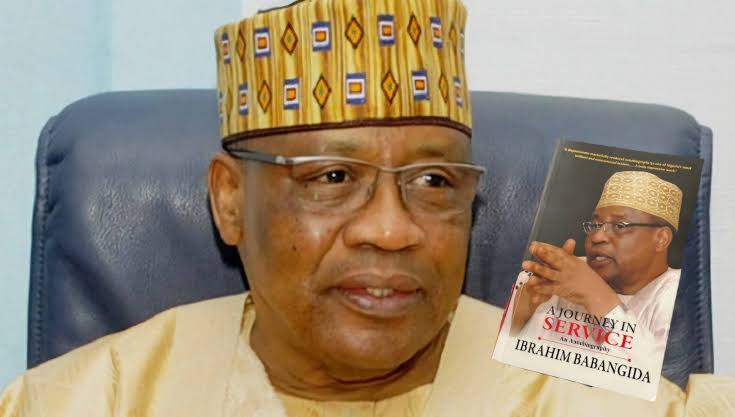
Babangida Admits Abiola Won June 12 Election, Expresses Regret Over Annulment.
Former military president General Ibrahim Babangida has admitted that the late Chief MKO Abiola won the June 12, 1993, presidential election, describing its annulment as a regrettable decision influenced by a military cabal led by General Sani Abacha.

Babangida made the revelation at the launch of his autobiography, A Journey in Service, where he reflected on the controversial decision that prevented Nigeria’s transition to democracy.

He acknowledged that the election was credible, free, and fair, but claimed he was outmanoeuvred by internal forces within his administration. He stated, “To suddenly have an announcement made without my authority was, to put it mildly, alarming. I later found out that the ‘forces’, led by General Abacha, annulled the elections. From then on, the June 12 elections took on a painful twist, for which I regrettably took responsibility.”
Babangida insisted that while the decision was a mistake, it was made in what he believed was the national interest. “Our nation’s march to democracy was interrupted, a fact I deeply regret. But Nigeria and democracy are still alive, a testament to commitment,” he said.
The events leading to the annulment, he explained, began when the Association for a Better Nigeria (ABN), led by Arthur Nzeribe, obtained a court injunction two days before the election, attempting to stop the vote. Babangida denied supporting ABN but admitted that political and legal battles over the election escalated tensions within the military leadership.
He also claimed that the then-Minister of Justice, Clement Akpamgbo, influenced legal proceedings in a way that undermined the electoral process. Despite resistance from top military officers, Babangida initially ordered the elections to proceed, only for results to be suspended on 16 June, without his prior approval.
By 23 June, while he was away in Katsina, Babangida learned that the elections had been officially annulled through a poorly worded statement read by his press secretary. “I was alarmed and horrified,” he recalled, adding that while annulment was considered among various options, it was never his intended course of action.
The election, widely regarded as Nigeria’s freest and fairest, saw Abiola of the Social Democratic Party (SDP) defeating Bashir Tofa of the National Republican Convention (NRC). Abiola secured 58.36% of the vote, including a victory in Tofa’s home state of Kano.
Following the annulment, mass protests erupted nationwide, while pro-democracy groups, including the National Democratic Coalition (NADECO), campaigned for the validation of the election results. Babangida eventually relinquished power on 27 August 1993, handing over to an interim government led by Chief Ernest Shonekan. However, three months later, General Abacha took over in a coup, leading to a period of military rule that saw further suppression of pro-democracy activists.
In 1994, Abiola declared himself the legitimate president but was arrested and detained by Abacha’s regime. He remained in custody until his controversial death on 7 July 1998, shortly after Abacha’s sudden demise.
Meanwhile, the Coalition of United Political Parties (CUPP) has called for the posthumous recognition of Abiola as a former president. CUPP’s national secretary, Chief Peter Ameh, urged President Bola Tinubu to take decisive action, stating that Babangida’s admission validated Abiola’s mandate.
“The annulment of the historic election was a turning point that plunged Nigeria into political chaos and weakened trust in the electoral process,” Ameh said. He emphasised that acknowledging Abiola’s presidency would be a step towards national reconciliation and strengthening democracy.
As Nigeria continues to reflect on the legacy of June 12, Babangida’s admission adds to the ongoing debate about accountability, democracy, and the country’s political history.
