
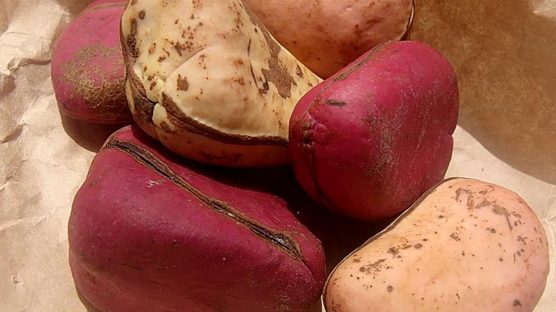
Oji’ referred to as kola nut, is clearly to be one of the very many customs that unites the Igbos’.
It is a valuable fruit of great importance in the Igbo community and other cultures. In Igbo land, kola nut is customarily presented to visitors as a token of welcome, hospitality and acceptance, along with other things like local drinks (palm wine, burukutu among others).
However, in ‘Ani Awkunanaw’ (Awkunanaw land) in Enugu state, before kola can be presented, it has to go through some elaborate customary processes led by the person that is administering the ritual.
Some of the processes are;

‘Ime Oji’ (presentation of kola nut) to ‘Icho Oji’ (passing of the kola) to ‘Igo Oji’ (praying over of the kola by a spiritual person or an elder) to ‘Iwa Oji’ (breaking or cutting of the kola) to ‘Ike Oji’ (sharing of the kola). In Awkunanaw, passing of the kola in a gathering is done in a hierarchical order. This forms the most important and symbolic point of kola nut presentation ceremony, which is also known as ‘icho oji’.
Holistically, the processes for icho oji in Awkunanaw land is traditionally connected with seniority or the oldest amongst all the kindreds or towns that made up the Awkunanaw community. The rule is that the kola moves in ascending order along the existing hierarchical structure of Awkunanaw. The common practice is that the kola nut in any Awkunanaw gathering is presented to the chairperson or anchor of the occasion to the kindreds, villages, or towns within the Awkunanaw land.
Among the villages in Awkunanaw, the traditional order of seniority are as follows;
- Akegbe Ugwu. Akwuke is a descendant brother from Akegbe Ugwu.
- Obuoffia
- Amodu
- Uma. Uma has two sons namely;
- Amechi
- Obeagu.
The two sons of Uma has a descendant brother called Ugwu aji.
- Umu Eze (Ada Awkunanaw).
IWA OJI
Iwa Oji is the cutting of the kola nut (that is, the separation of the lobes of the kola nut) is reserved for the youngest among the sons of Awkunanaw. In a sitting like this, as listed above in the seniority structure, the mantle falls on ‘Obeagu’.
In this case, the youngest man from this community passes the kola nut round as the anchor or the chairperson calls on representative from each community in their hierarchical order. Also, in a gathering of or sitting of the individual villages, the responsibility of Iwa Oji falls on the youngest person while if it is a full Awkunanaw setting, the responsibility falls on the youngest which is Obeagu.
WOMEN
Traditionally, in Awkunanaw, the kola nut can not be presented to, cut or served by a woman. The rites of the Kola nut does not recognise women and this is why they are not included in the ritual. Rather, their role is to prepare spicy ‘okwa ose’ or ‘ose oji’ (alligator pepper or groundnut sauce) for the consumption of the kola. Moreso, before a woman can dip her hands and take kola, a man or a boy has to take the kola out of the spectacle and give to them. As such, women are not permitted to dip their hands in the kola nut tray to take kola in the presence of the men.
Within each town in Awkunanaw land, Icho Oji or Iwa Oji operates or goes through same principles which is the traditional order of seniority among the sons of Awkunanaw.
