
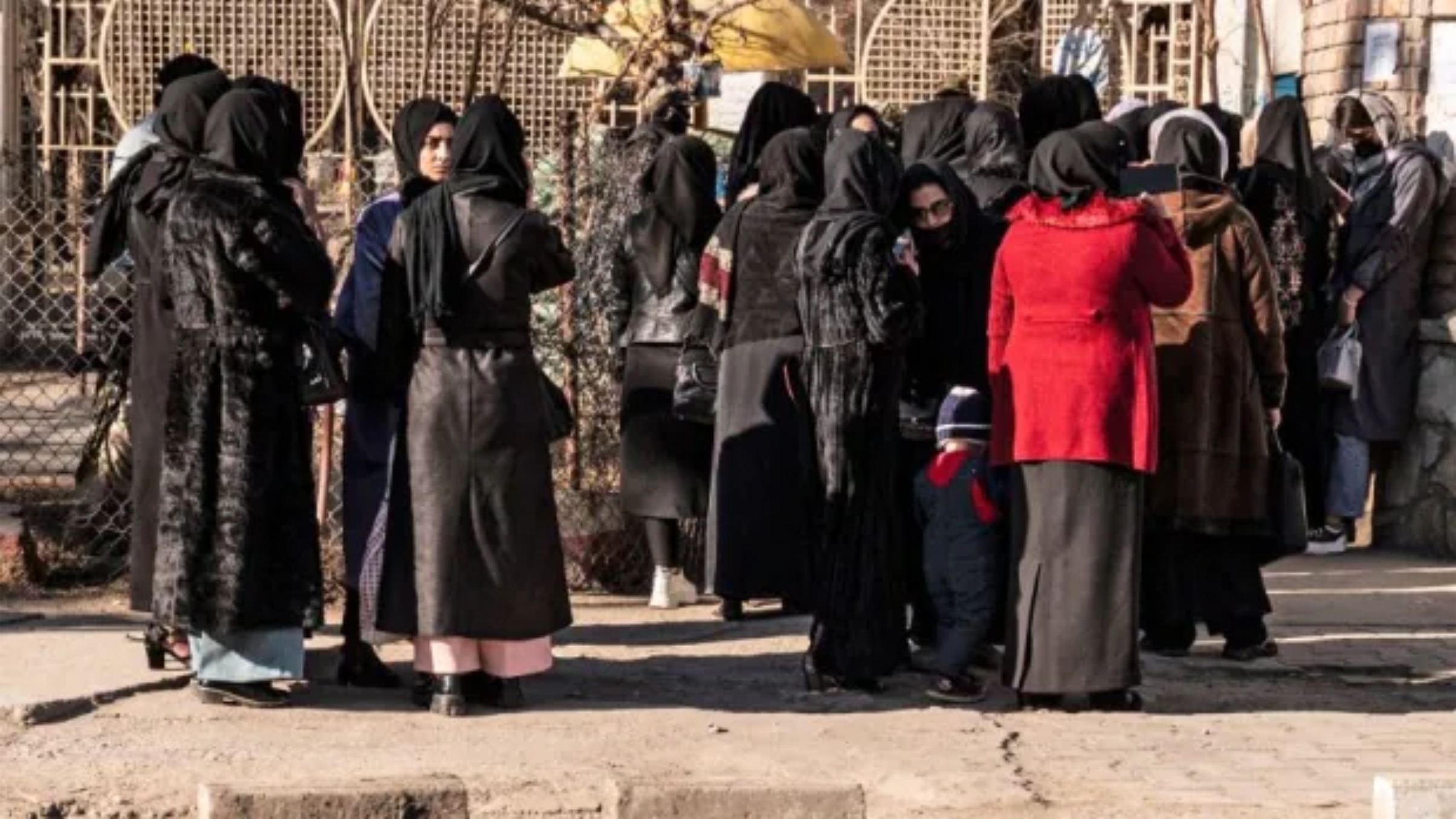
Afghan universities reopened on Monday after a winter break, but only men returned to class with a “heartbreaking” ban by the Taliban authorities on women in higher education still in force.
The university ban is one of several restrictions imposed on women since the Taliban stormed back to power in August 2021, and has sparked global outrage even across the Muslim world.
“It’s heartbreaking to see boys going to the university while we have to stay at home,” said Rahela, 22, from the central province of Ghor.
“This is gender discrimination against girls because Islam allows us to pursue higher education. Nobody should stop us from learning.”
The Taliban government imposed the ban after accusing women students of ignoring a strict dress code and a requirement to be accompanied by a male relative to and from campus.

Most universities had already introduced gender-segregated entrances and classrooms, as well as allowing women to be taught only by female professors or elderly men.
“It’s painful to see that thousands of girls are deprived of education today,” Mohammad Haseeb Habibzadah, a student of computer science at Herat university, told AFP.
“We are trying to address this issue by talking to lecturers and other students so that there can be a way where boys and girls could study and progress together.”
Ejatullah Nejati, an engineering student at Kabul University, Afghanistan’s largest, said it was a fundamental right of women to study.
“Even if they attend classes on separate days, it’s not a problem. They have a right to education and that right should be given to them,” he said as he entered the university campus.
Government fear
Waheeda Durrani, a journalism student in Herat until she was barred from university last year, said the Taliban government wanted women to remain uneducated.
“If Afghan girls and women get educated, they will never accept a government that exploits Islam and the Koran,” she said.
“They will stand for their rights. That’s the fear the government has.”
At the capital’s private Rana university male students trickled back to classes on Monday.
“My sister, unfortunately, cannot come to the university. She is trying to study at home,” said Ebratullah Rahimi, another journalism student.
Posters dating from before the ban showing how women needed to dress were still on display in the university corridors.
Several Taliban officials say the ban on women’s education is temporary but, despite promises, they have failed to reopen secondary schools for girls, which have been closed for more than a year.
The authorities have wheeled out a litany of excuses for the closure, from a lack of funds to the time needed to remodel the syllabus along Islamic lines.
The reality, according to some Taliban officials, is that the ultra-conservative clerics advising Afghanistan’s supreme leader Hibatullah Akhundzada are deeply sceptical of modern education for women.
Taliban authorities have effectively squeezed women out of public life since retaking power.
Women have been removed from many government jobs or are paid a fraction of their former salary to stay at home.
They are also barred from going to parks, fairs, gyms and public baths, and must cover up in public.
Rights groups have condemned the restrictions, which the United Nations called “gender-based apartheid”.
The international community has made the right to education for women a sticking point in negotiations over aid and recognition of the Taliban government.
No country has so far officially recognised the Taliban as Afghanistan’s legitimate rulers.
AFP
