
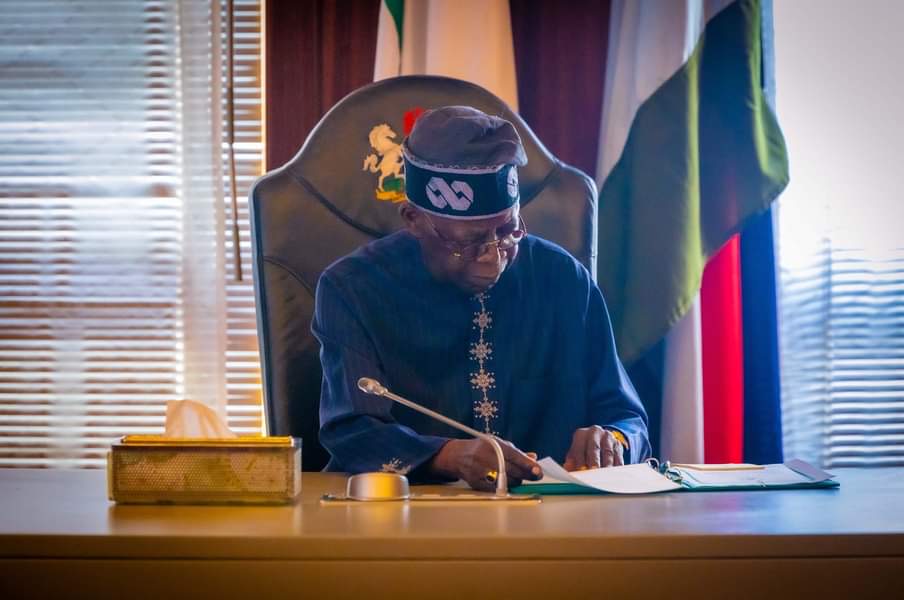
In an effort to address persistent power outages in Nigeria, President Bola Tinubu has sanctioned the gradual settlement of power sector debts, totaling over N3.3 trillion.
The Federal Government plans to pay approximately N1.3 trillion owed to power generating companies (Gencos) through a combination of cash injections and promissory notes. Additionally, about $1.3 billion (N1.994 trillion) owed to gas companies will be cleared using cash and future royalties.
The announcement was made by the Minister of Power, Chief Adebayo Adelabu, during the 8th Africa Energy Marketplace in Abuja, themed “Towards Nigeria’s Sustainable Energy Future: Policy, Regulation, and Investment.” The government has already initiated cash payments for part of the N1.3 trillion owed to Gencos, with plans to settle the remaining amount through promissory notes over two to five years.
Adelabu explained that President Tinubu has directed the Minister of Finance to disburse N130 billion from the Gas Stabilisation Fund to Gencos.

The remaining debt to gas companies will be paid from future royalties and income streams, which gas suppliers find satisfactory. This new arrangement aims to establish firm supply contracts with gas companies, ensuring a consistent gas supply to power generators.
The minister highlighted ongoing issues with policy coordination in the power sector, emphasizing the administration’s commitment to removing industry bottlenecks.
He also justified the recent Band A tariff hike, affecting only 15% of Nigerians, and linked it to the power reform agenda.
The Federal Government’s initiative also includes generating 700MW from the Zungeru hydroelectric power plant, increasing Nigeria’s total electricity output to 5,000MW.
President Tinubu has also approved the use of cash injections and promissory notes to encourage Gencos to boost their generation capacity.
Additionally, the Federal Government has paid $120 million of the $1.3 billion gas debt, a move that has improved electricity supply, as gas operators who had reduced supply due to unpaid debts resumed operations. Nigeria relies on thermal power plants for over 70% of its electricity, with the remainder from hydropower plants.
The African Development Bank (AfDB) is also poised to support Nigeria’s energy reforms with a $1 billion policy-based operation.
The AfDB aims to enhance the power sector’s efficiency and productivity through investments like the $256.2 million Nigeria Transmission Expansion Project and the $200 million Nigeria Electrification Project.
These projects will construct transmission lines, substations, and mini-grids, and explore Battery Energy Storage Systems to stabilize the grid and promote renewable energy.
Former Minister of Power Barth Nnaji and 2023 Labour Party presidential candidate Peter Obi have called for a state of emergency in the power sector.
Nnaji advocated for the construction of a super grid to prevent frequent grid collapses and enhance power transmission infrastructure. He expressed concern over gas shortages in the power sector despite Nigeria’s abundant gas reserves and urged the government to balance gas production for export and domestic use.
Ghana’s former President, John Mahama, highlighted that Ghana, with significantly less population, generates and distributes more electricity than Nigeria, emphasising the need for Nigeria to improve its power infrastructure. He urged African leaders to plan for rising energy demands and stressed the importance of reliable power for economic growth.
The lecture, organized by Ovation Magazine publisher Dele Momodu, sought to address Nigeria’s persistent electricity challenges, which have persisted despite substantial investments in the power sector.
Attendees included Governor Ademola Adeleke of Osun State, former Governor Rabiu Kwankwaso of Kano State, former Governor Donald Duke of Cross River State, and the Ooni of Ife, Oba Adeyeye Ogunwusi.
