
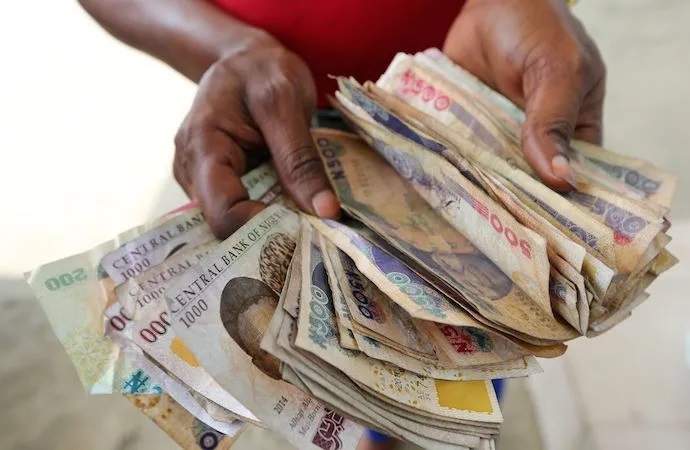
Across major markets, prices of goods are moving away from the lower denomination of the Naira currencies as inflation bites harder.
Not too long ago, a sachet of pure water cost N5, while N20 gained popularity as the denomination used to “settle” police officers at checkpoints.
However, in the past couple of years, these notes have struggled to get items they could be attached to.
A market survey by Daily Post showed that more than half of Nigeria’s legal tenders cannot make purchases.

Despite this, the Central Bank of Nigeria, CBN, recognizes the following denominations; 50 kobo, N1 and N2 which are coins, and N5, N10, N20 and N50 which are printed on polymer materials.
A sachet of pure water now sells for N30. Retailed sugar no longer sells for N10, while candies like Tom Tom are retailed at two pieces for N50. To further compound the woes of these notes, goods are now rounded up to 50 or 100, which further makes these currencies irrelevant.
In the past six months, the Naira has depreciated considerably. At one point, it was about N1,900 to a single dollar until the intervention by the CBN with the naira now trading at about N1050 to a dollar.
The implication of it is that N1000, which is Nigeria’s highest denomination, is less than a single dollar.
Anyone with $1000 is a millionaire in naira based on the current exchange rate, and anyone with $1 has more than N1,000.
Despite the recent surge in the value of naira, prices of commodities have not shown any significant signs of climbing down.
Experts believe that Nigeria’s inflation is a product of many factors, with FX being one of the numerous factors.
But despite this, the Nigerian government is still printing some of the lower denomination currencies at a huge cost.
According to reports, in 2016, CBN had to temporarily halt the printing of N5, 10, N20 and N50 due to the cost of production.
The report said it costs N1000 to print each lower denomination because Nigeria Security Printing and Minting plc (NSPM) is unable to print on polymer.
Now experts are calling on the CBN to discontinue the printing of the lower denominations and review the currencies in line with realities.
Abiodun Ayangbemi, an economist, told newsmen that the CBN must discontinue the printing of the lower denomination because the majority of those currencies have failed the basic principles of money— means of exchange and store of value.
“The monetary authorities cannot continue to print those denominations when there is basically nothing to use them for,” he said.
Lekan Olaleye, a monetary policy expert, asked the federal government to take a copy of the re-denomination policy adopted by Ghana some years back.
He argued that the CBN should remove two zeros from the existing notes.
It would be recalled that Ghana had in 2007, re-denominated the Cedis by striking out four zeros from their currency and producing the new Ghana Cedis.
A former CBN Governor, Sanusi Lamido had in 2012 announced a plan to introduce N5000 notes. In the same vein, there was also a plan to coin the lower bank notes of N5, N10 and N20.
However, the policy was met with a strong outcry from the public, who condemned the plan. Thus, the government shelved the plan.
Years after the botched plan, prices of goods and services have spiked beyond the 2012 level.
(Daily Post)
