
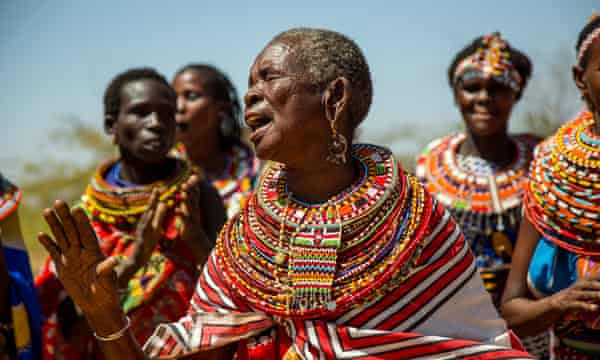
The Umoja Uaso is an all-female matriarch.
In the aftermath of British rule, over 1,400 women became pariahs some of whom found solace in a small village protected by a fence of thorns and barbed wire.
Men are forbidden from living in this sanctuary to this day.
Umoja Uaso (“unity” in Swahili and due to its location near Uaso Nyiro river) is an all-female tribe in Samburu County, Kenya. Closed off from the outside world, the village is like a bandaid for women survivors of violence and genital mutilation and their young ones. Here, all women are welcome to stay, raise their children, date, and enjoy freedom from Samburu traditions of female subordination and find economic empowerment.

Break away
The Among the Samburu people, when a case was brought up against the British military for the rape of over 1,400 Samburu women, many husbands abandoned their wives because they saw them as ‘defiled’. Other men chased their wives for fear of contracting sexually transmitted diseases.
In the Samburu traditions, women are not allowed to own land or livestock. They are also viewed as property of their husbands and can be subjected to genital mutilation, and forced marriages.
One of the founders of Umoja Uaso, Rebecca Lolosoli, came up with the idea of a women-only village when she was recovering from physical abuse after speaking up against female genital mutilation.
In 1990, the village was started with fifteen women.
Retaliation
In response to this move, the men established their own villages nearby. They also set up a rival craft business and would try to intercept tourists who tried to visit Umoja. All these attempts were futile and eventually, the women bought the land the men had occupied.
Lolosoli’s husband attacked the village in 2009 and threatened her life which led the women into hiding for a while. She was also taken to court by men of a neighbouring village over the establishment.
To sustain the community, the women of Umoja run a primary school, a cultural centre, and a camping site for tourists visiting Samburu National Reserve. They also create and sell jewellery and home-brewed low-alcohol beer at Umoja Waso Women’s Cultural Centre.
Each woman donates 10 percent of her earnings as tax to the village to support communal activities.
Social organisation
They live in a clustered community of Manyata huts which are surrounded by a fence of thorns and barbed wire. All residents must wear traditional clothing and beadwork of the Samburu people.
They take in runaways or girls who have been thrown out of their households and raise orphans, abandoned children, and children with HIV.
Boys who are raised in the village are required to leave when they turn 18.
Men are allowed to visit but not to stay.
Only those men who were raised in the village are allowed to sleep there.
Women can date men outside the village.
Women can also have children outside of wedlock.
Recognition
They are supported by Kenya’s Heritage and Social Services and the Ministry of Culture. Their application for a community title over grazing land is still undergoing government consideration.
Under the “tree of speech,” the women gather to make decisions. Lolosoli acts as the chairperson, and all women are of equal status in the village.
