
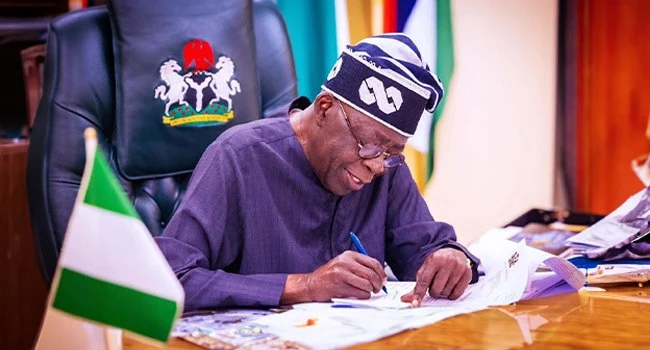
Nigeria’s path to food security calls for visionary leadership, consistent investment and a real commitment to improving the conditions farmers face. President Bola Ahmed Tinubu’s increasing focus on agricultural financing, support for smallholder farmers and the development of the agricultural value chain signals an important understanding: agriculture must play a central role in transforming Nigeria’s economy.
The reported ₦450 billion commitment to agricultural financing programmes, along with approval of a proposed ₦1.5 trillion recapitalisation of the Bank of Agriculture, marks a significant policy push to reposition the sector. These steps also show the President’s willingness to tackle longstanding barriers that have kept Nigerian farmers from reaching their full productive potential.
For a country rich in agricultural resources, where more and more people are worried about the cost of food, this renewed focus on farming is both timely and essential.
President Tinubu deserves credit for recognising that food security cannot depend on imports and emergency measures alone. Nigeria needs to boost domestic production, empower farmers, attract investment in agriculture and build a resilient food system that can meet the needs of its growing population.

A shift from subsistence farming to productive agriculture
One of the most important parts of the administration’s agricultural interventions is its focus on smallholder farmers. They play a major role in Nigeria’s food production, but many have long faced barriers to finance, quality seeds, fertiliser, modern equipment and dependable markets.
The reported support for more than 500,000 smallholder farmers through the Bank of Agriculture is therefore significant. The Renewed Hope Smallholder Support and Value Chain Fund, valued at ₦250 billion, aims to tackle some of these challenges through farmer aggregation companies, input distribution, extension services and stronger market links.
The reported distribution of around 2.5 million bags of fertiliser and 300,000 bags of certified seeds shows the value of getting agricultural support directly to the people working the land.
Just as importantly, this approach recognises that farmers need more than funding. They need the right conditions for access to inputs, practical agricultural knowledge, technology and markets to come together and lift productivity.
This kind of thinking could, over time, help reshape the story of Nigerian agriculture.
The Bank of Agriculture recapitalisation: Investing in the future of farmers
The proposed ₦1.5 trillion recapitalisation of the Bank of Agriculture deserves close attention. It reflects a clear intention to strengthen the country’s dedicated agricultural finance institution and give it greater capacity to support farmers, cooperatives, processors and agricultural entrepreneurs.
For too long, limited access to affordable finance has held back growth in the sector. Commercial loans often don’t suit farmers, whose costs and income follow seasonal production cycles.
A stronger Bank of Agriculture could help close this gap by offering credit that is both more accessible and better suited to the realities of farming.
The significance of the President’s approval goes beyond the size of the proposed investment. It offers a chance to build a more reliable agricultural finance system, one that can serve smallholder farmers and large-scale agricultural businesses alike.
But the institution will need the right resources and systems to ensure funding reaches genuine farmers, especially in rural communities that are often overlooked by conventional banks.
Northern Nigeria: Unlocking an enormous agricultural opportunity
The President Tinubu-led administration’s focus on agricultural production in Northern Nigeria is especially important. The region has strong potential in grain production, rice and wheat cultivation, onions, tomatoes, livestock, legumes and many other agricultural commodities.
States including Kaduna, Kano, Katsina, Niger, Borno, Gombe, Taraba, Adamawa, Yobe and Bauchi can all make a significant contribution to strengthening Nigeria’s food production.
Efforts to expand dry-season farming, support onion production, revive ginger farming and introduce agricultural mechanisation show a clear understanding of the opportunities these states offer.
The onion financing initiative, developed with the National Onion Producers, Processors and Marketers Association of Nigeria, is a good example of how targeted support across an agricultural value chain can boost production and create more commercial opportunities.
Similarly, the Nigeria Ginger Recovery Programme’s support for farmers in Kachia, Kaduna State, highlights the importance of restoring agricultural commodities that have been hit by production challenges.
These initiatives need sustained attention. Agricultural development in Northern Nigeria affects not only food availability, but also jobs, rural incomes and the country’s economic stability.
The next step, however, must be to strengthen irrigation, rural roads, storage and processing facilities, while improving security for farming communities.
Mechanisation and technology: Giving farmers the tools to grow
Another promising part of the administration’s agricultural agenda is its focus on mechanisation and modern farming technology.
The reported distribution of 1,571 tractors across 23 states, with the capacity to mechanise 1.2 million hectares, is a meaningful step towards easing the burden of manual farming.

The planned provision of 100,000 solar irrigation pumps and 44,000 electric cargo tricycles through the productive-use-of-electricity programme also reflects a wider view of what it takes to raise agricultural productivity.
Farming cannot rely on outdated methods forever. Farmers need machinery, affordable energy, irrigation, better practices and technology that can bring down production costs.
These investments could make agriculture more appealing to young people, help farmers work more efficiently and increase local food production.
The administration should build on this progress, while making sure the equipment is well maintained and available to farming communities at affordable rates.
Women and young people must share in agricultural prosperity
The initiatives reportedly aimed at reaching 50,000 women through insured cooperative financing, alongside programmes to bring more young people into agriculture, are also worthy of recognition.
Women are vital to food production, processing and distribution. Still, many face persistent obstacles when it comes to owning land, securing financing and accessing the equipment they need.
Giving women access to finance, cooperative support and stronger market opportunities can help rural households thrive and enable more women to take part in the economy.
Young Nigerians, too, should be able to see agriculture as a profitable business. Simply urging them to return to the land isn’t enough. They need financing, technology, training, land, equipment and real commercial opportunities.
A modern agricultural economy should offer opportunities across the value chain, not just for farmers, but also for people working in processing, transport, storage, packaging, agricultural technology and marketing.
From government commitment to measurable national impact
While the President’s commitment to giving agriculture more attention is welcome, the real test will be whether these initiatives are carried out effectively and improve Nigerians’ lives.
Their success should be evident in higher agricultural output, better incomes for farmers, fewer post-harvest losses, stronger rural businesses and more affordable food.
The Bank of Agriculture must also work transparently, efficiently and accountably. Nigerians should be able to see how funds are used, how farmers are chosen, how much land is cultivated and what economic benefits result.
The government must also keep tackling insecurity in farming communities, high transport costs, insufficient storage and infrastructure gaps that hold back agricultural production.
These points are not a rejection of the administration’s vision for agriculture. They are essential to turning that vision into lasting progress.
A defining opportunity for Nigeria’s agricultural future
President Tinubu’s reported commitments to agricultural financing and the proposed recapitalisation of the Bank of Agriculture offer a chance to rethink how Nigeria supports agricultural development.
His willingness to invest in farmers, strengthen agricultural institutions and tackle challenges across the food value chain is worth recognising. More importantly, it suggests a shift towards treating agriculture as a productive sector, one that needs reliable financing, technology, infrastructure and long-term institutional support.
Nigeria must make the most of this opportunity.
The country has the land, people, agricultural diversity and entrepreneurial drive to build a food system that feeds its population while creating jobs and wealth.
What matters now is consistency, effective delivery and making sure each intervention brings measurable results.
The true test of this vision will be whether farmers earn more, young people find worthwhile careers in agribusiness, rural communities prosper and Nigerian households can afford nutritious food.
President Tinubu has shown a real willingness to change how agricultural financing works and to empower farmers. The task now is to build on that commitment, strengthen the reforms and make sure agricultural transformation delivers tangible benefits for Nigerian farmers and consumers.
Food security is essential to national security. When farmers thrive, the economy grows. And a productive agricultural sector is an investment in Nigeria’s future.
