
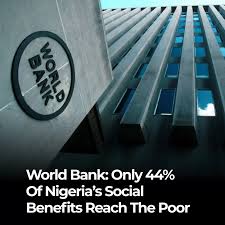
A recent report by the World Bank titled “The State of Social Safety Nets in Nigeria” (November 2025), has delivered a sobering indictment of Nigeria’s social protection architecture. Key among its findings: although approximately 56 % of the recipients of the country’s safety‑net schemes are classified as poor, just 44 % of the total benefits disbursed actually reach those poor households.
What the Numbers Show
-
The report reveals that while more than half (56 %) of beneficiaries of government‑sponsored social safety‑net programmes are poor, those poor households receive only 44 % of total benefits.
-
This gap manifests an efficiency and targeting problem: programmes are not only under‑funded, but the benefit structure dilutes support for those who arguably need it the most.
-
One of the structural issues: many programmes allocate a fixed amount per household, rather than individual amounts. Since poorer households tend to be larger, the per‑person benefit is smaller. The report states: “Benefit levels for most programs … are determined at the household level, but poor people tend to live in larger households.”

-
By contrast, programmes that target individuals (rather than households) — such as the National Home‑Grown School Feeding Programme (NHGSFP) — are less affected by this dilution, but their coverage is limited (e.g., only pupils in Grades 1‑3, and not full national reach).
Why This Matters
-
Poverty Remains Deep and Widespread: Nigeria has a very large number of people living below the poverty line; many of them vulnerable to economic shocks, inflation, and insecure livelihoods. The small share of benefits reaching the poor means the social safety‑net system is not yet fulfilling its protective role.
-
Inequality and Household Size Issues: The design of “one amount per household” tends to favour smaller households (which on average may be less poor) and disfavour larger, poorer households where the benefit must stretch further.
-
Fiscal and Design Inefficiencies: The report warns that Nigeria’s spending on social protection is very low as a share of GDP — for instance around 0.14 % of GDP — compared to global or regional averages.
-
Missed Opportunity for Poverty Reduction: The report estimates that at current levels and designs, the safety‑net programmes only reduce the national poverty headcount by about 0.4 percentage points. That is minimal, given the scale of need.
Underlying Factors Identified
The report identifies a number of structural and operational issues hindering the effectiveness of social benefits reaching the poor:
-
Poor Targeting and Benefit Design: The “per household” benefit structure, as mentioned above, dilutes impact for larger poor households.
-
Low Coverage and Low Benefit Levels: Many programmes cover a modest number of people and provide modest transfers, reducing their capacity to significantly lift households out of poverty.
-
Fragmented Implementation and Coordination: The report suggests that federal, state, and local programmes often overlap or fail to coordinate, which erodes efficiency.
-
Heavy Dependence on Donor Financing: Between 2015‑2021, the report notes that about 60 % of federal safety‑net spending came from official development assistance, with the World Bank alone accounting for over 90 % of that donor share — raising questions of sustainability.
-
Size and Composition of Households: Poorer households tend to be larger, so the “one size fits all” household‑based benefit makes each individual’s share smaller in such households.
Implications & Recommendations
Given these findings, the report and analysts suggest several paths forward:
-
Move Towards Individual‑Based or Per‑Person Benefits, rather than only per‑household transfers, to ensure equity especially where poorer households are larger.
-
Increase the Scale of The Programmes — both coverage (reach more poor households) and adequacy (higher transfer amounts) — so that the safety nets can have meaningful impact.
-
Strengthen the Targeting and Data Systems: For example, the National Social Safety Nets Programme (NASSP), uses a national registry for poor households — the report sees this as promising.
-
Improve Coordination Between Federal, State, and Local Layers, streamlining programmes to reduce overlap and leakage.
-
Build Fiscal Space for Sustainable Social Protection, reducing undue dependence on donor funding and ensuring long‑term stability.
-
Implement Programmes That Target Individuals: (such as the school‑feeding programme) and scale them up in coverage, to reduce the household‑size distortion.
Nigeria’s Current Context
Nigeria’s economic and social landscape means that getting social protection right is critical:
-
Inflation, cost‑of‑living pressures, unemployment, and informal employment all weigh heavily on the poorest households.
-
A large share of the population lives in insecure employment or livelihoods, meaning they are vulnerable to shocks (illness, job loss, and inflation).
-
The government has announced initiatives: for example, the Minister of Finance and Coordinating Minister of the Economy, Wale Edun, stated that a digital cash‑grant scheme targets 15 million households (70 million people), with monthly payments of ₦25,000, out of which about 8.5 million households have already received a first tranche.
-
Yet, despite these initiatives, the World Bank deems the overall safety‑net expenditure and design inadequate for delivering large‑scale poverty reduction.
Conclusion
The World Bank’s report starkly highlights that less than half of the benefits designed for poor Nigerians are actually reaching them. This underscores a major gap between policy ambition and implementation reality in our social protection system.
Unless programme design is improved (especially to account for household size), benefit levels are increased, and coverage expanded — and unless funding and coordination are strengthened — the safety nets will continue to deliver modest results at best.
For this narrative to change, resolving this inefficiency is not just a matter of policy‑tweaking: it is central to achieving broader goals of poverty reduction, human capital development, and inclusive growth.
